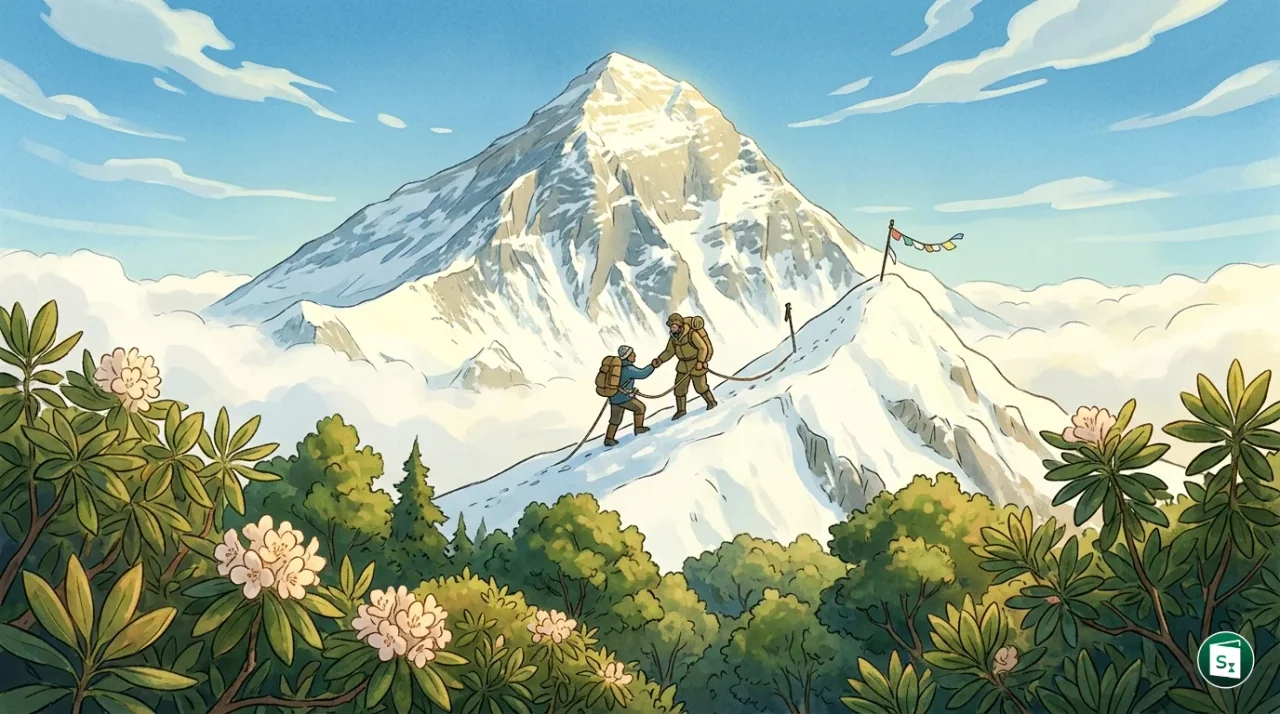
International Everest Day was observed on May 29, 2026, marking the 73rd anniversary of the historic first ascent of the world’s highest peak by Sir Edmund Hillary and Tenzing Norgay Sherpa. This year’s commemoration arrived amidst a record-shattering spring climbing season that saw more than 1,000 climbers reach the summit, even as authorities implemented the most stringent environmental regulations in the mountain’s history. Beyond mere celebration, the day highlighted the urgent need for sustainable mountaineering to protect the “Water Tower of Asia” from the dual threats of overcrowding and climate change.
History and Significance of International Everest Day
International Everest Day commemorates the moment on May 29, 1953, at 11:30 AM, when Sir Edmund Hillary of New Zealand and Tenzing Norgay Sherpa became the first humans to stand on the summit of Mount Everest. The 9th British Mount Everest Expedition, led by Colonel John Hunt, achieved this feat via the Southeast Ridge route, which remains the most popular path for climbers today. While Hillary was a beekeeper and mountaineer from New Zealand, Tenzing Norgay was a Sherpa who had settled in Darjeeling, India, and is celebrated as a national hero in both Nepal and India.
The official observance of the day began in 2008, when the Government of Nepal declared May 29 as International Everest Day following the passing of Sir Edmund Hillary. The day serves as a global tribute to human courage and the collaborative spirit of international expeditions. It also provides a significant platform for honoring the Sherpa community, whose expertise and labor are the backbone of Himalayan mountaineering. In 2026, the theme “Sagarmatha: Identity and Pride of Nepal” underscored the mountain’s central role in the nation’s cultural and economic life.
The 2026 Everest Season: A Year of Unprecedented Records
The 2026 spring climbing season has been etched into history as the most successful and record-heavy period since the mountain was first conquered. For the first time, more than 1,000 climbers reached the summit in a single season, surpassing the previous high of 877 set in 2019. This surge was partially driven by the continued closure of the Tibet (North) side of the mountain, which funneled nearly all international expeditions to the Nepal side. Consequently, Nepal issued a record 494 permits to foreign climbers, generating over $7 million in revenue.
The “Everest Man” and Global Milestones
The season witnessed several historic individual achievements that redefined the limits of human endurance:
- Kami Rita Sherpa: The legendary guide, often called the “Everest Man”, reached the summit for a record 32nd time on May 17, 2026. He holds the world record for the most successful ascents of any 8,000-meter peak.
- Lhakpa Sherpa: The most successful female Everest climber extended her own record by reaching the summit for the 11th time.
- Kenton Cool: The British mountaineer set a new benchmark for non-Sherpa climbers by completing his 20th summit.
- Tyler Andrews: On May 28, Andrews set a new speed record by trekking from Everest Base Camp to the summit in just 9 hours and 55 minutes using supplemental oxygen.
One of the most striking sights of the season occurred on May 21, 2026, when a record 275 climbers reached the top in a single day during a perfect weather window, highlighting both the mountain’s popularity and the logistical challenges of overcrowding.
Environmental Stewardship and “Poop Bags”: Cleaning the Peak
To combat Everest’s reputation as the “world’s highest garbage dump,” the Sagarmatha Pollution Control Committee (SPCC) and the Nepali government enforced the strictest environmental mandates in the mountain’s history during the 2026 season. A key regulation is the 8kg Garbage Rule, which requires every climber to bring back at least 8 kilograms of trash from above Base Camp. To ensure compliance, expeditions must pay a $4,000 refundable deposit, which is forfeited if the waste quota is not met.
The 2026 season also saw the full-scale implementation of mandatory biodegradable “poop bags” for all climbers operating above Base Camp. These bags contain chemicals that solidify human waste and neutralize odors, requiring climbers to carry their waste back down to be disposed of properly. This measure aims to address the long-standing issue of human waste polluting the mountain’s high-altitude environment and water sources.
Innovation played a critical role in waste management this year. For the first time, heavy-lift drones were deployed to transport empty oxygen cylinders and accumulated trash from Camp I and Camp II down to Base Camp. This technological intervention significantly reduces the number of dangerous trips Sherpas must make through the treacherous Khumbu Icefall, enhancing both environmental cleanliness and climber safety. Despite these efforts, environmental scientists warned on Everest Day that the South Col Glacier continues to thin at an alarming rate due to global warming, losing decades of ice thickness every year.
Mount Everest: Geography, Nomenclature, and the India Connection
The world’s highest peak stands at an official height of 8,848.86 meters, a figure established through a joint survey by Nepal and China in 2020. Located in the Mahalangur Himal sub-range of the Himalayas, the mountain straddles the border between Nepal and the Tibet Autonomous Region of China. While known globally as Mount Everest, it is called Sagarmatha (Goddess of the Sky) in Nepal and Chomolungma (Mother Goddess of the World) in Tibet.
India shares a deep and historic connection with the mountain. In 1852, it was an Indian mathematician and surveyor, Radhanath Sikdar, who first calculated the height of “Peak XV,” identifying it as the highest point on Earth. The mountain was later named after Sir George Everest, a former Surveyor General of India. During the successful 1953 expedition, India provided crucial logistical support. Tons of equipment arrived via Bombay (Mumbai), and an Indian wireless station at Namche Bazaar served as the expedition’s vital communication link to the outside world.
Following the 1953 success, Prime Minister Jawaharlal Nehru founded the Himalayan Mountaineering Institute (HMI) in Darjeeling in 1954 to commemorate the achievement and promote the spirit of adventure. Tenzing Norgay, who lived most of his life in Darjeeling, served as the institute’s first Director of Field Training. Today, the Tenzing Norgay National Adventure Award remains India’s highest honor for achievements in adventure sports, preserving the legacy of the legendary climber.
The Way Forward: Sustainability and Safety
As Everest Day 2026 concluded, the conversation shifted toward the future of high-altitude tourism. The record-breaking number of permits has sparked a debate on the “commodification” of Everest, with experts calling for stricter eligibility criteria for climbers. A proposed regulation requiring Everest aspirants to have previously summited a 7,000-meter peak in Nepal is expected to be fully enforced by 2027 to ensure that only experienced mountaineers attempt the world’s highest peak.
Furthermore, the introduction of mandatory GPS tracking chips for all climbers in 2026 has already improved search and rescue efficiency. As climate change continues to alter the Himalayan landscape, the focus for the coming decade will be on “ethical and community-centered tourism.” This approach seeks to balance the economic benefits of mountaineering with the preservation of the delicate alpine ecosystem and the well-being of the local Sherpa communities who remain the true guardians of Sagarmatha.
Key Takeaways
- International Everest Day is observed annually on May 29 to mark the first successful ascent of the world’s highest peak by Sir Edmund Hillary and Tenzing Norgay in 1953.
- The official height of Mount Everest is 8,848.86 meters, a standard jointly established and recognized by Nepal and China in 2020.
- Nepali guide Kami Rita Sherpa extended his own world record by completing his 32nd successful summit of Mount Everest on May 17, 2026.
- The 2026 spring season was the busiest in history, with more than 1,000 climbers reaching the summit and a single-day record of 275 summits on May 21.
- In 2026, authorities implemented a mandatory 8kg garbage rule and the use of biodegradable poop bags to combat pollution on the mountain.
- The height of Mount Everest (then known as Peak XV) was first calculated in 1852 by Indian mathematician Radhanath Sikdar during the Great Trigonometrical Survey.
- The Himalayan Mountaineering Institute (HMI) was established in Darjeeling in 1954 to honor the first summit and is where Tenzing Norgay served as the first Director of Field Training.