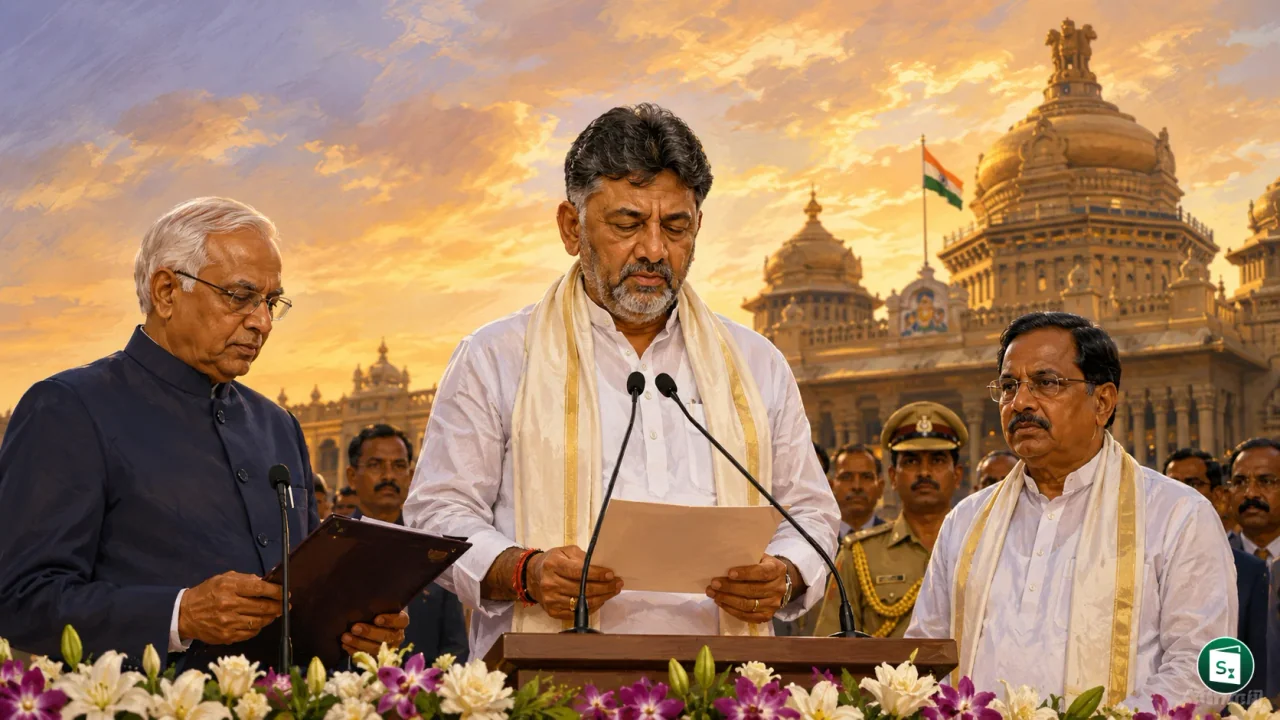
In a planned political transition, D.K. Shivakumar was sworn in as the 25th Chief Minister of Karnataka on June 3, 2026, succeeding Siddaramaiah who resigned as part of a power-sharing arrangement. The oath of office and secrecy was administered by Governor Thaawarchand Gehlot at Bengaluru. Senior leader Dr. G. Parameshwara was also sworn in as the Deputy Chief Minister of the state.
The Leadership Transition in Karnataka
The political transition in Karnataka followed a premeditated agreement within the ruling party. Former Chief Minister Siddaramaiah submitted his resignation to the Governor on May 28, 2026, facilitating the succession. The transition ensures continuity in the state administration while fulfilling internal party understandings.
The swearing-in ceremony was held at the Glass House in Lok Bhavan, Bengaluru. Governor Thaawarchand Gehlot administered the oath to both the Chief Minister and the Deputy Chief Minister. This event marks the beginning of a new administrative tenure for the state, focusing on welfare schemes and developmental projects.
Constitutional Provisions for Chief Minister and Ministers
The appointment and functioning of the Chief Minister and the Council of Ministers in Indian states are governed by specific constitutional mandates. These rules ensure the democratic functioning and accountability of the executive branch to the state legislature.
Appointment of the Chief Minister and Council of Ministers
Under Article 164(1) of the Constitution of India, the Chief Minister is appointed by the Governor, while other ministers are appointed by the Governor on the advice of the Chief Minister. The ministers hold office during the pleasure of the Governor. According to Article 164(2), the Council of Ministers is collectively responsible to the State Legislative Assembly.
The size of the Council of Ministers is restricted by Article 164(1A), which was introduced by the 91st Constitutional Amendment Act, 2003. This clause limits the total number of ministers, including the Chief Minister, to 15% of the total membership of the Legislative Assembly, and it must not be less than 12. Since the Karnataka Legislative Assembly has 224 seats, the maximum permissible strength of the state’s cabinet is 34 ministers.
The Position of the Deputy Chief Minister
The post of Deputy Chief Minister is not explicitly mentioned or defined in the Constitution of India. It is a political designation often used to accommodate senior leaders or balance coalition dynamics. A Deputy Chief Minister holds the rank of a Cabinet Minister and receives the same salary and allowances as other ministers, without any special constitutional authority or veto power over other departments.
The Supreme Court of India has repeatedly upheld the validity of appointing a Deputy Chief Minister. In a significant ruling in February 2024, a three-judge bench led by Chief Justice of India D.Y. Chandrachud clarified that the designation does not violate the Constitution. The court ruled that describing a person as a Deputy Chief Minister is merely an appellation and does not confer any superior powers or privileges compared to other ministers. As long as the appointee takes the prescribed oath as a minister under the Third Schedule and meets all constitutional eligibility criteria, the designation is legally valid.
Karnataka Legislative and Executive Structure
Karnataka has a bicameral legislature, consisting of both a Legislative Assembly (Vidhan Sabha) and a Legislative Council (Vidhan Parishad). The state’s administrative and legislative organs are organized as follows:
| Component | Detail | Remarks / Key Data |
|---|---|---|
| Governor | Thaawarchand Gehlot | Constitutional head of the state, administers the oath of office |
| Chief Minister | D.K. Shivakumar | Head of government and leader of the ruling party |
| Deputy Chief Minister | Dr. G. Parameshwara | Senior cabinet minister assisting the Chief Minister |
| Legislative Assembly (Vidhan Sabha) | 224 Seats | Lower House of the state legislature, members elected directly |
| Legislative Council (Vidhan Parishad) | 75 Seats | Upper House of the state legislature, members elected indirectly |
| Lok Sabha Seats | 28 Constituencies | Representation of Karnataka in the Lower House of Parliament |
| Rajya Sabha Seats | 12 Seats | Representation of Karnataka in the Upper House of Parliament |
This administrative setup forms the core governance framework of Karnataka, enabling legislative creation and executive implementation of state policies.
Key Takeaways
- D.K. Shivakumar was sworn in as the 25th Chief Minister of Karnataka on June 3, 2026, succeeding Siddaramaiah.
- The oath of office and secrecy was administered by the Governor of Karnataka, Thaawarchand Gehlot, at Bengaluru.
- Dr. G. Parameshwara took the oath of office as the Deputy Chief Minister of the state.
- The appointment of a Chief Minister by the Governor is guided by Article 164(1) of the Constitution of India.
- According to Article 164(1A), the Council of Ministers, including the Chief Minister, is limited to 15% of the Legislative Assembly’s total membership, meaning Karnataka can have a maximum of 34 ministers.
- The Supreme Court of India in February 2024 reaffirmed that appointing a Deputy Chief Minister is constitutionally valid as it is only a political appellation carrying the rank of a Cabinet Minister.