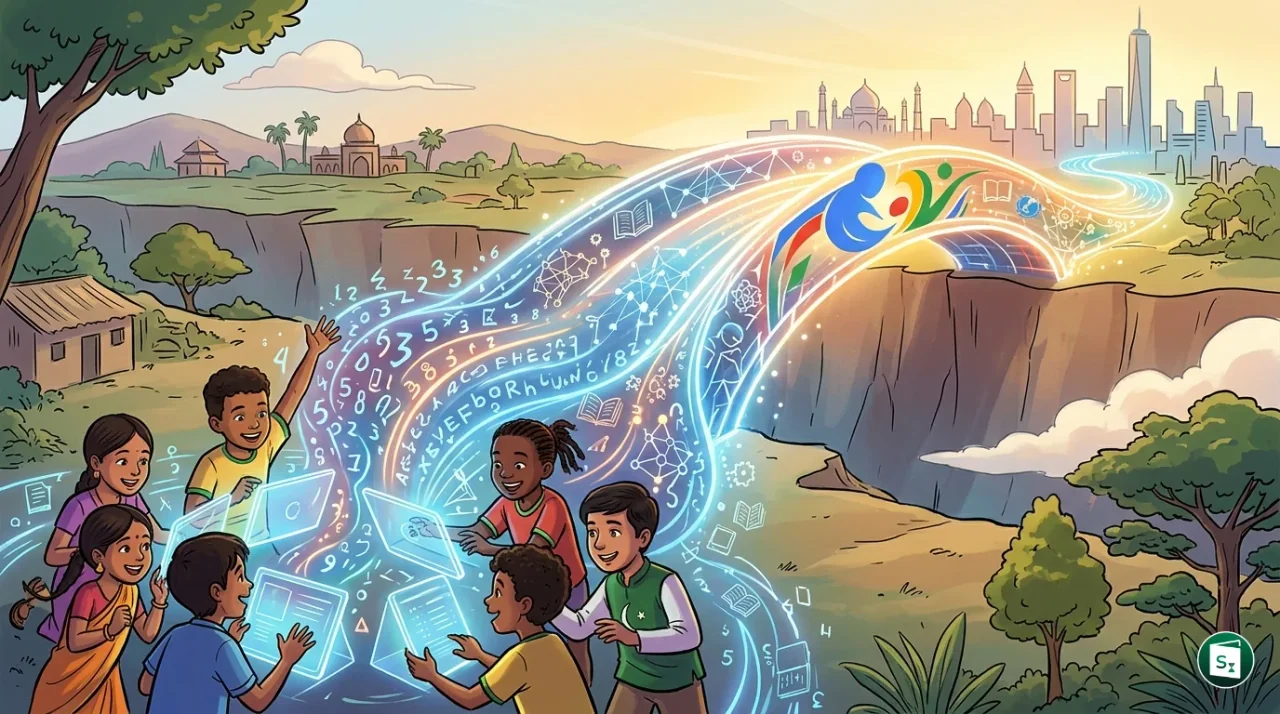
Google and the United Nations Children’s Fund (UNICEF) announced a three-year global partnership at the Education World Forum (EWF) 2026 in London to deploy artificial intelligence-powered learning tools and digital resources. The initiative targets students and educators in Brazil, India, Kenya, and Pakistan to bridge the digital divide and improve foundational literacy and numeracy. By combining technological innovation with localized expertise, the collaboration seeks to build resilient educational systems in regions facing significant digital disparities.
Strategic Objectives of the Partnership
The three-year partnership focuses on addressing critical deficits in foundational learning, particularly literacy and numeracy, which are the cornerstones of all future educational attainment. Millions of students in low- and middle-income countries lack access to personalized instruction and digital learning resources, which worsens existing educational inequalities. Supported by Google.org, the philanthropic arm of Google, the initiative aims to deploy technology that adapts to individual student needs while equipping teachers with tools to manage diverse classrooms.
A key objective of the program is to address the digital divide by ensuring that technology is not just accessible, but also contextually relevant. Rather than deploying a one-size-fits-all solution, Google and UNICEF are collaborating with national governments, local educators, and community leaders to customize the tools. This ensures that the digital resources align with national curriculum standards and respect local languages and cultural contexts, which are crucial for the sustainability of educational reforms.
AI-Powered Tools for Foundational Learning
The partnership leverages a suite of Google’s advanced artificial intelligence applications to create interactive, adaptive, and highly accessible environments for students and teachers. These tools are designed to work across varying levels of digital infrastructure, including offline capabilities for regions with limited internet connectivity.
Scaling Read Along for Foundational Literacy
The initiative focuses heavily on scaling Read Along by Google, a specialized literacy application that helps children learn to read through interactive guidance. Originally launched in India as Bolo on March 6, 2019, the application was designed to improve Hindi and English reading skills. It was rebranded as Read Along in 2020 for global expansion.
Read Along features an in-app reading assistant named Diya, which uses Google’s speech recognition and text-to-speech technologies to listen to children as they read aloud. Diya provides immediate feedback, helping children correct errors and rewarding progress with digital badges. Crucially, the speech recognition runs entirely on the device, allowing the application to function offline and ensuring child privacy because no voice data is transmitted to external servers.
Adaptive Learning with Gemini and NotebookLM
Beyond reading, the initiative introduces Gemini for Education and NotebookLM to enhance teaching practices and personalize instruction. Gemini helps teachers draft customized lesson plans, create worksheets, and design study guides tailored to students with different learning speeds. NotebookLM, an AI-powered note-taking and research assistant, is used to synthesize complex local textbooks into structured study notes, enabling teachers to quickly adapt lessons to diverse classroom requirements.
Regional Implementation and Country-Specific Initiatives
The three-year project is tailored to the specific educational landscapes and digital challenges of each target country, ensuring that local governments are key implementation partners.
India’s NEP 2020 Alignment and the Google AI Educator Series
In India, the initiative is structured to support the primary goals of the National Education Policy (NEP) 2020, which prioritizes foundational literacy, numeracy, and technology integration in early education. To complement the UNICEF partnership, Google launched the Google AI Educator Series (GES). This mobile-first training initiative helps K-12 and higher education teachers integrate generative AI tools like Gemini into classroom instruction and administrative work.
To ensure broad access across non-urban areas, the Google AI Educator Series is localized into six Indian languages: Assamese, Hindi, Marathi, Odia, Punjabi, and Telugu. The initiative is rolled out in collaboration with the state governments of Maharashtra, Chhattisgarh, Assam, Punjab, and the Union Territory of Ladakh, providing modular training sessions that reward teachers with digital badges upon completion.
Focus on Brazil, Kenya, and Pakistan
The implementation strategies in the other three countries address unique regional vulnerabilities:
- Pakistan: The project leverages Read Along to deliver adaptive literacy training at scale, aiming to address the high rate of out-of-school children and help them catch up to their grade-level competencies.
- Kenya: Google and UNICEF are collaborating with the Ministry of Education to run pilot teacher-training programs and establish policy guidelines for expanding internet connectivity and device access in remote rural schools.
- Brazil: The focus is on integrating AI tools into public school networks, adapting software interfaces to regional Portuguese dialects, and evaluating how digital tools reduce achievement gaps between public and private school students.
Institutional Background and Governance
To understand the scope and implementation of this global partnership, it is important to analyze the background of the implementing organizations and the forum where the announcement was made.
| Entity/Forum | Establishment / Founding | Headquarters / Location | Key Details |
|---|---|---|---|
| UNICEF (United Nations Children’s Fund) | December 11, 1946 | New York City, United States | Governed by a 36-member Executive Board elected by ECOSOC. Led by Executive Director Catherine M. Russell. Awarded the Nobel Peace Prize in 1965. |
| Education World Forum (EWF) | 2002 | London, United Kingdom | The world’s largest annual gathering of education and skills ministers. Hosted by the UK’s Department for Education and supported by the British Council. |
| Google.org | 2005 | Mountain View, California, United States | The philanthropic arm of Google that supports global non-profit initiatives through financial grants and technological support. |
Key Takeaways
- Google and UNICEF announced a three-year global partnership at the Education World Forum (EWF) 2026 in London to deploy artificial intelligence education tools.
- The initiative targets students and educators in four countries: Brazil, India, Kenya, and Pakistan to improve foundational literacy and numeracy.
- Read Along by Google, originally launched in India as Bolo on March 6, 2019, will be scaled to support reading fluency and comprehension.
- In India, the partnership is aligned with the National Education Policy (NEP) 2020 alongside the launch of the mobile-first Google AI Educator Series (GES).
- The Google AI Educator Series supports six Indian languages including Assamese, Hindi, Marathi, Odia, Punjabi, and Telugu.
- UNICEF was founded on December 11, 1946, and is headquartered in New York City with Catherine M. Russell serving as its Executive Director.