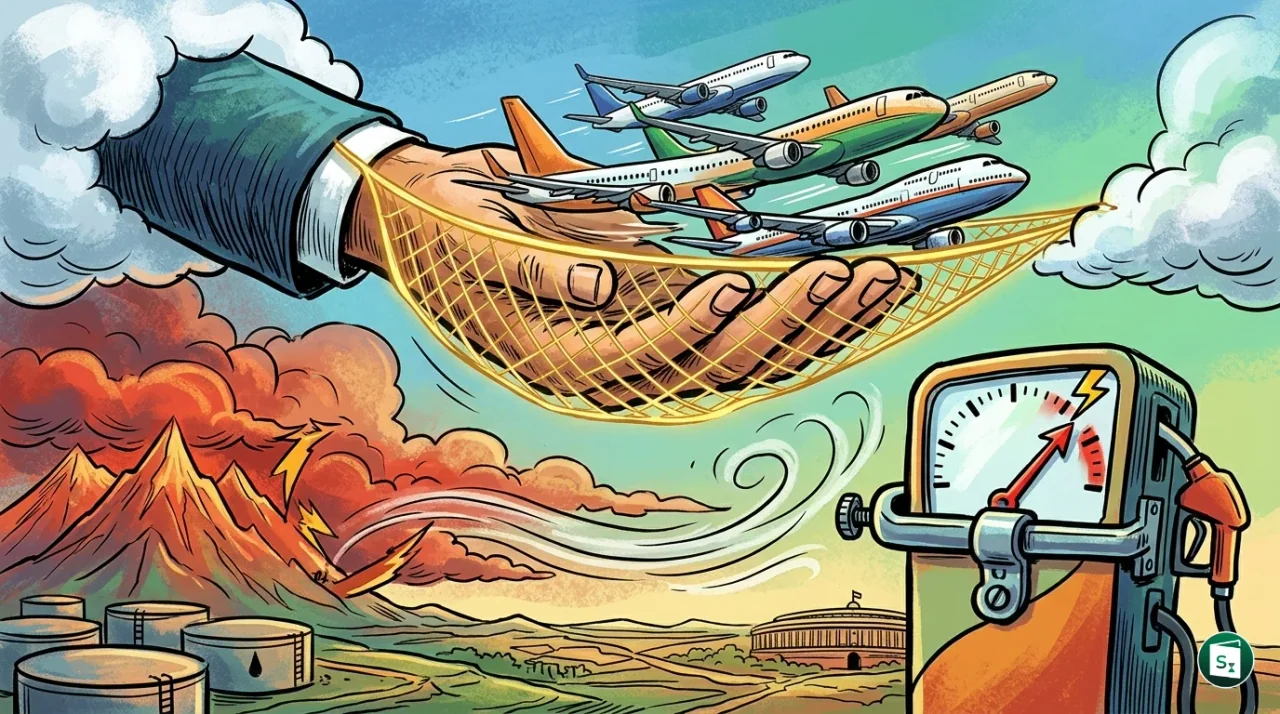
The Union Cabinet approved a ₹10,000 crore Price Stabilisation Fund on June 3, 2026, to shield scheduled Indian airlines from the volatility of global jet fuel prices. Under this 36-month scheme, the government will provide interest-free advances to public sector Oil Marketing Companies to cap domestic prices of Aviation Turbine Fuel at ₹115 per litre. This intervention aims to protect airline operations, control domestic airfare hikes, and maintain air connectivity during international oil market disruptions.
Mechanism of the Aviation Turbine Fuel Price Stabilisation Fund
The newly approved mechanism works by routing interest-free advances directly to public sector Oil Marketing Companies (OMCs), including Indian Oil Corporation Limited (IOCL), Bharat Petroleum Corporation Limited (BPCL), and Hindustan Petroleum Corporation Limited (HPCL). This financial support is administered through the Ministry of Petroleum and Natural Gas. The principal goal of these advances is to cover the under-recoveries that OMCs face when selling jet fuel below its international market rate.
To participate in this price stabilisation arrangement, scheduled Indian airlines must enter into a Memorandum of Understanding (MoU) with the OMCs. Under this agreement, the airlines commit to procuring their fuel exclusively from these OMCs for the duration of the support. In return, the OMCs cap the sale price of Aviation Turbine Fuel (ATF) at ₹115 per litre for both domestic and international operations.
| Parameter | Details of the Scheme |
|---|---|
| Total Allocation | ₹10,000 crore interest-free advance |
| Scheme Duration | 36 months |
| ATF Price Cap | ₹115 per litre |
| Implementing Agencies | Ministry of Petroleum and Natural Gas, Ministry of Civil Aviation, OMCs |
| Eligible Beneficiaries | Scheduled Indian airlines (domestic and international flights) |
Restoring Balance: The Recovery and True-Up Mechanism
The financial structure of the Price Stabilisation Fund relies on a recovery and true-up mechanism. The ₹10,000 crore allocation is not a direct subsidy or grant. Instead, it acts as an interest-free advance that the OMCs must eventually repay to the government.
This recovery occurs when international crude oil and ATF prices decline below the benchmark price level. Once global prices stabilize and return to normal ranges, the OMCs will pay back the advance. All recovered funds will be deposited back into the Consolidated Fund of India, which is established under Article 266(1) of the Constitution of India. This arrangement ensures that the fiscal support remains self-sustaining and does not create a long-term drain on public finances.
An inter-ministerial monitoring committee will oversee the implementation, verification of claims, and financial settlements of the scheme. This committee consists of senior representatives from the Ministry of Civil Aviation, the Ministry of Petroleum and Natural Gas, and the Department of Expenditure under the Ministry of Finance.
The Rising ATF Cost Crisis and Impact on Aviation
Aviation Turbine Fuel constitutes the largest single operating expense for Indian airlines, accounting for 40% to 50% of their total operational costs. Consequently, any significant fluctuations in fuel prices have an immediate impact on the financial health of the sector. The domestic aviation industry has been facing severe operational challenges due to rising global crude oil prices, primarily driven by the ongoing West Asia geopolitical crisis.
Between March 2026 and May 2026, international jet fuel prices experienced a steep surge. In India, domestic ATF prices rose from approximately ₹60.50 per litre to ₹142 per litre over this two-month period. This rapid rise strained the cash flow of airline companies, increased risk for smaller domestic carriers, and forced airlines to raise ticket prices. High fares began to reduce passenger growth and threatened regional connectivity projects, particularly the flights operating under the UDAN regional airport development scheme.
Taxation of Jet Fuel in India: Excise Duty and State VAT
A key factor behind the high cost of jet fuel in India is its taxation structure. Unlike most goods and services, ATF remains outside the Goods and Services Tax (GST) regime. Under Article 279A(5) of the Constitution of India, five petroleum products (crude oil, high-speed diesel, motor spirit (petrol), natural gas, and ATF) can only be brought under the GST regime upon the recommendation of the GST Council.
Because jet fuel is excluded from GST, it is taxed under the older dual-tax system:
- Central Excise Duty: The central government levies a standard excise duty of 11% on ATF, which is reduced to 2% for operations under the Regional Connectivity Scheme (UDAN).
- State Value Added Tax (VAT): Individual state governments levy VAT, with rates varying significantly across different states, ranging from 0% to 29%.
This dual system prevents airlines from claiming input tax credits on fuel purchases, creating a cascading tax effect that raises operational expenses. While the civil aviation sector has frequently advocated for incorporating ATF under the GST system to establish a uniform national rate, the GST Council has not yet made a formal decision. In the interim, the Price Stabilisation Fund provides a temporary financial buffer against price volatility.
Key Takeaways
- The Union Cabinet approved a ₹10,000 crore Price Stabilisation Fund on June 3, 2026, to support scheduled Indian airlines against rising jet fuel costs.
- The stabilization support scheme will operate for a period of 36 months and caps the sale price of Aviation Turbine Fuel at ₹115 per litre.
- Under the scheme, OMCs receive interest-free advances that are later recovered and returned to the Consolidated Fund of India, established under Article 266(1) of the Constitution.
- Aviation Turbine Fuel is kept outside the GST regime under Article 279A(5) of the Constitution, leaving it subject to central excise duty and state Value Added Tax.
- The standard central excise duty on Aviation Turbine Fuel is 11%, which is reduced to 2% for operations under the UDAN regional connectivity connectivity scheme.