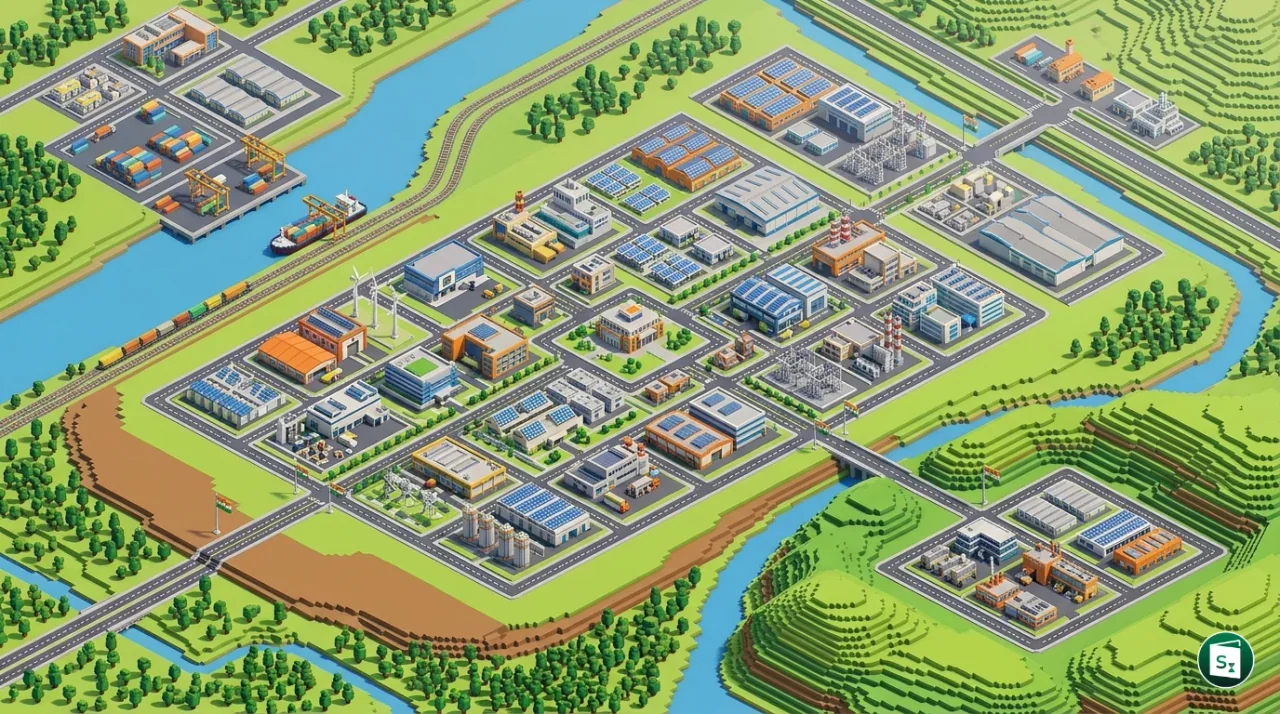
The Department for Promotion of Industry and Internal Trade released the operational guidelines for the BHAVYA Scheme on May 25, 2026, marking a major step towards modernizing India’s industrial landscape. This ₹33,660 crore Central Sector initiative aims to establish 100 investment-ready, world-class industrial parks by 2032 to attract global manufacturing giants. By focusing on “plug-and-play” infrastructure and competitive selection, the government seeks to eliminate traditional hurdles like land acquisition and utility setup for new businesses.
What Is the BHAVYA Scheme?
The BHAVYA (Bharat Audyogik Vikas Yojana) scheme is a flagship Central Sector initiative designed to transform India into a global manufacturing hub. Approved by the Union Cabinet in early 2026, the scheme carries a total financial outlay of ₹33,660 crore. Its primary objective is the development of 100 world-class industrial parks over a six-year implementation period, spanning from FY 2026-27 to FY 2031-32.
The scheme is administered by the Department for Promotion of Industry and Internal Trade (DPIIT), which operates under the Ministry of Commerce & Industry. DPIIT was originally established in 1995 as the Department of Industrial Policy and Promotion (DIPP) and was renamed in 2019 to reflect its expanded mandate over internal trade. Headquartered in New Delhi, the department is the nodal body for formulating and implementing industrial policy in India.
Competitive Selection: The Challenge-Based Model
A defining feature of the BHAVYA scheme is the move away from traditional discretionary allocations to a challenge-based competitive selection process. This ensures that central funding is directed toward projects with the highest viability and the strongest commitment from state governments.
In the first phase, the government aims to select up to 50 industrial parks. The selection process is divided into two distinct rounds:
- Round 1: Applications are open from June 1 to July 31, 2026, with a target of selecting up to 20 proposals.
- Round 2: The window for the remaining 30 proposals opens from August 1 to September 30, 2026.
Proposals are evaluated based on a rigorous scoring system. Key parameters include multimodal connectivity (aligned with the PM Gati Shakti National Master Plan), land suitability, and infrastructure readiness. Furthermore, states that have implemented significant reforms in land allotment and single-window clearance systems are given priority.
Infrastructure Standards and Land Norms
The BHAVYA guidelines provide a flexible yet structured approach to land requirements to accommodate the varying geographical conditions across India. The scheme permits the development of both greenfield (new developments) and eligible brownfield (expansion of existing sites) industrial parks.
The land requirements are categorized based on the region:
| Region Category | Minimum Land Requirement |
|---|---|
| Non-hilly States | 100 acres |
| Hilly and Northeastern States | 25 acres |
| Union Territories and Smaller States | 25 acres |
The guidelines also include provisions to support larger parks, with a maximum size of up to 1,000 acres. This scalability allows for the creation of massive industrial clusters that can benefit from economies of scale and shared common facilities.
Financial Assistance and Strategic Integration
To ensure the creation of high-quality infrastructure, the BHAVYA scheme offers substantial financial support. The Centre provides assistance of up to ₹1 crore per acre for internal infrastructure, which includes roads, utility corridors, water and power supply systems, and digital ICT networks. Additionally, the scheme supports external connectivity (last-mile links to highways and railways) by covering up to 25% of the total project cost.
The scheme is anchored by the National Industrial Corridor Development Corporation (NICDC), which serves as the Project Management Agency (PMA). NICDC leverages its expertise in developing Industrial Smart Cities like Dholera and Greater Noida to ensure that BHAVYA parks meet global standards.
Key strategic features of the scheme include:
- Plug-and-Play Ecosystem: Industrialists get pre-approved land with ready-built factory sheds and pre-installed utility links, allowing them to move from “intent to production” almost immediately.
- Sustainability Mandates: Parks must include Common Effluent Treatment Plants (CETPs) and Zero Liquid Discharge (ZLD) systems. There is also a strong emphasis on integrating renewable energy and green building standards.
- Multimodal Connectivity: Every park is required to be structurally synchronized with national freight corridors, ports, and highways under the framework of PM Gati Shakti.
Governance and Monitoring Mechanism
The implementation of the BHAVYA scheme follows a robust institutional framework to ensure transparency and accountability. Projects are executed through Special Purpose Vehicles (SPVs), which are incorporated under the Companies Act, 2013. These SPVs are typically formed as partnerships between the National Industrial Corridor Development and Implementation Trust (NICDIT) and respective state government nodal agencies.
A National Level Steering Committee, chaired by the Secretary of DPIIT, provides overall supervision and policy direction. To maintain real-time oversight, the government has mandated the use of GIS-based live monitoring systems and periodic third-party audits. This digital approach allows the DPIIT to track construction progress and identify potential bottlenecks early.
Beyond physical infrastructure, the guidelines emphasize social infrastructure to support the industrial workforce. Parks are required to provide integrated worker housing, health centers, and skill-development facilities within or near the premises. Furthermore, these parks will be benchmarked against the Industrial Park Rating System (IPRS), a national tool used to rate industrial hubs based on performance and utility availability.
Key Takeaways
- The BHAVYA (Bharat Audyogik Vikas Yojana) scheme is a Central Sector initiative with a total financial outlay of ₹33,660 crore to develop 100 world-class industrial parks.
- The scheme is implemented by the Department for Promotion of Industry and Internal Trade (DPIIT) over a six-year period from FY 2026-27 to FY 2031-32.
- In the first phase, the government will select 50 industrial parks through a challenge-based competitive selection process starting in June 2026.
- The minimum land requirement for the parks is set at 100 acres for general states and 25 acres for hilly states, Northeastern states, and Union Territories.
- The Centre offers financial assistance of up to ₹1 crore per acre for internal core infrastructure and up to 25% of the project cost for external connectivity.
- The National Industrial Corridor Development Corporation (NICDC) serves as the official Project Management Agency for the implementation of the scheme.