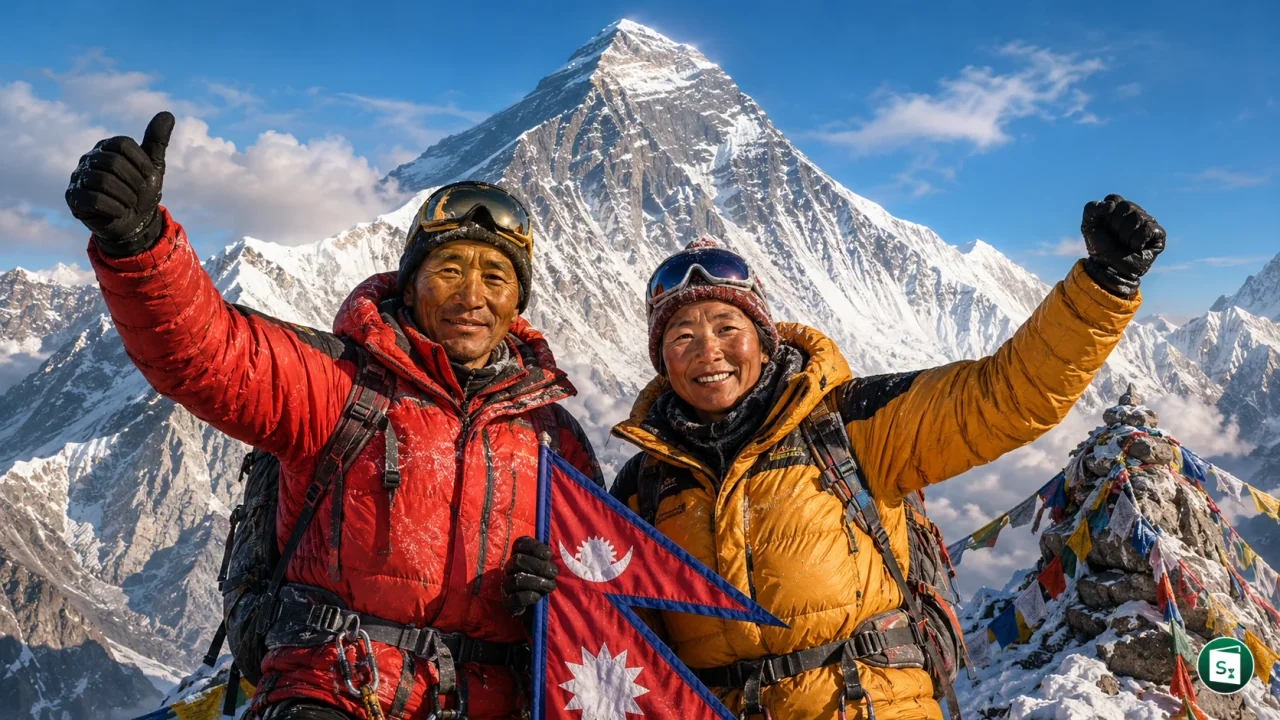
On May 17, 2026, two veteran Nepali climbers, Kami Rita Sherpa and Lhakpa Sherpa, reached the summit of Mount Everest, further cementing their status as the world’s most prolific mountaineers. While Kami Rita scaled the peak for a record-extending 32nd time, Lhakpa Sherpa reached the top for her 11th successful ascent, setting a new benchmark for women climbers globally. These achievements come amid a historic climbing season marked by record permit numbers and stringent new environmental regulations on the world’s highest mountain.
Legendary Feat: Kami Rita Sherpa’s 32nd Everest Ascent
Kami Rita Sherpa, widely revered as the “Everest Man,” successfully reached the 8,848.86-meter summit at 10:12 AM local time on May 17, 2026. This achievement marked his 32nd successful climb of the world’s highest peak, extending his own world record for the most summits by any individual. At 56 years old, Kami Rita led an expedition organized by 14 Peaks Expedition, taking the traditional Southeast Ridge route from the Nepal side.
His mountaineering career began with his first successful ascent on May 13, 1994. Over the three decades since, he has become a symbol of the Sherpa community’s unparalleled skill and endurance. Beyond Everest, Kami Rita holds the record for the most total summits of mountains exceeding 8,000 meters, with over 43 successful climbs, including peaks like K2, Lhotse, and Cho Oyu.
Upon his return to Kathmandu, Kami Rita addressed the growing concerns regarding overcrowding on the mountain. He urged the Nepal government and tourism authorities to implement stricter limits on the number of climbing permits issued each season. He noted that “traffic jams” in the Death Zone (the region above 8,000 meters where oxygen levels are insufficient to sustain human life) have made the peak increasingly dangerous even for experienced climbers.
Breaking Barriers: Lhakpa Sherpa Sets New Female Record
On the same morning that Kami Rita made history, Lhakpa Sherpa, known as the “Mountain Queen,” reached the summit for the 11th time. At 52 years old, she successfully guided a client to the peak as part of an expedition with Seven Summit Adventure, reaching the top at approximately 9:30 AM. Her achievement further extends her own record for the most Everest summits by a woman.
Lhakpa Sherpa’s journey is unique in the world of professional mountaineering. Despite her global records, she has famously balanced her climbing career with working as a dishwasher at a supermarket in Connecticut, USA. Her first successful ascent occurred on May 18, 2000, when she became the first Nepali woman to reach the summit of Everest and survive the descent. Since then, she has summited the peak from both the Nepal (South) and Tibet (North) sides.
Her extraordinary life and dedication were the subject of the 2023 documentary titled “Mountain Queen: The Summits of Lhakpa Sherpa.” Beyond Everest, she also successfully climbed K2, the world’s second-highest peak, in July 2023. Her 11th Everest summit in 2026 reinforces her position as an inspiration for women in high-altitude sports.
Mount Everest: Geography, Naming, and Global Significance
Mount Everest is situated in the Mahalangur Himal sub-range of the Himalayas, precisely on the international border between Nepal and the Tibet Autonomous Region of China. Following a joint announcement by Nepal and China in December 2020, the official height of the peak is recognized as 8,848.86 meters (29,031.7 feet). This measurement includes the snow cap on the summit.
The History of Its Names
The mountain is known by various names across different cultures. In Nepal, it is called Sagarmatha, which translates to “Forehead of the Sky.” In Tibet, its ancient name is Chomolungma or Qomolangma, meaning “Goddess Mother of the World.” Before being named Everest, it was identified by the Great Trigonometrical Survey of India as Peak XV.
The peak was renamed in 1865 in honor of Sir George Everest, a British surveyor who served as the Surveyor General of India from 1830 to 1843. Interestingly, Radhanath Sikdar, an Indian mathematician and surveyor, was the first to calculate the height of the mountain in 1852 using trigonometric measurements.
Geological and Environmental Context
Everest is a Fold Mountain, formed by the continuous collision of the Indo-Australian Plate and the Eurasian Plate. This tectonic activity causes the mountain to rise by approximately 1 millimeter every year. The region is often referred to as the “Third Pole” due to its massive ice reserves. In Nepal, the peak is protected within Sagarmatha National Park, a UNESCO World Heritage Site.
Major Mountaineering Milestones
| Milestone | Achievement | Year |
|---|---|---|
| First Successful Ascent | Sir Edmund Hillary and Tenzing Norgay | 1953 |
| First Indian to Summit | Captain Avtar Singh Cheema | 1965 |
| First Woman to Summit | Junko Tabei (Japan) | 1975 |
| First Indian Woman | Bachendri Pal | 1984 |
| First Nepali Woman | Pasang Lhamu Sherpa | 1993 |
The Evolving Challenges and Regulations of Modern Mountaineering
The 2026 climbing season has been historic for its administrative and environmental shifts. To manage the increasing number of climbers and protect the fragile ecosystem, the Nepal Department of Tourism issued a record 495 permits for Everest alone. This surge in popularity has necessitated the introduction of several mandatory regulations to address safety and pollution.
New Eligibility and Safety Rules
For the first time in 2026, a significant eligibility requirement was implemented. All climbers applying for an Everest permit must have successfully summited at least one 7,000-meter peak in Nepal. This rule aims to ensure that only experienced mountaineers attempt the world’s highest peak, thereby reducing the likelihood of accidents caused by inexperience. Additionally, the use of heavy-load drones was introduced to ferry supplies and oxygen to higher camps, reducing the number of dangerous trips Sherpas must make through the hazardous Khumbu Icefall.
Environmental and Waste Management
To combat the reputation of Everest as the world’s highest garbage dump, authorities have enforced strict waste management protocols:
- The 8kg Garbage Rule: Every climber is required to bring back at least 8 kilograms of garbage from above Base Camp to reclaim their deposit.
- Mandatory Poop Bags: Climbers must now use biodegradable bags provided by the Sagarmatha Pollution Control Committee (SPCC) to ensure all human waste is removed from the mountain.
- High-Altitude Cleanup: A specific mandate requires bringing down 2 kilograms of waste from the high-altitude camps (Camp III and IV) where pollution is most critical.
These measures are part of a broader effort to mitigate the impacts of climate change. Rapid melting of the Khumbu Glacier has already led to discussions about moving the Everest Base Camp to a more stable, lower-altitude location in the near future.
Key Takeaways
- Kami Rita Sherpa set a new world record by successfully scaling Mount Everest for the 32nd time on May 17, 2026.
- Lhakpa Sherpa, known as the “Mountain Queen,” broke her own record for women climbers with her 11th successful ascent.
- The official elevation of Mount Everest is 8,848.86 meters, as jointly declared by Nepal and China in 2020.
- The peak is traditionally known as Sagarmatha (Forehead of the Sky) in Nepal and Chomolungma (Goddess Mother of the World) in Tibet.
- The first successful summit of Everest was achieved on May 29, 1953, by Sir Edmund Hillary and Tenzing Norgay.
- Bachendri Pal made history in 1984 as the first Indian woman to reach the summit of Mount Everest.
- Radhanath Sikdar, an Indian mathematician, was the first to calculate the mountain’s height (then Peak XV) in 1852.
- New regulations in 2026 require climbers to have summited a 7,000-meter peak in Nepal before being eligible for an Everest permit.