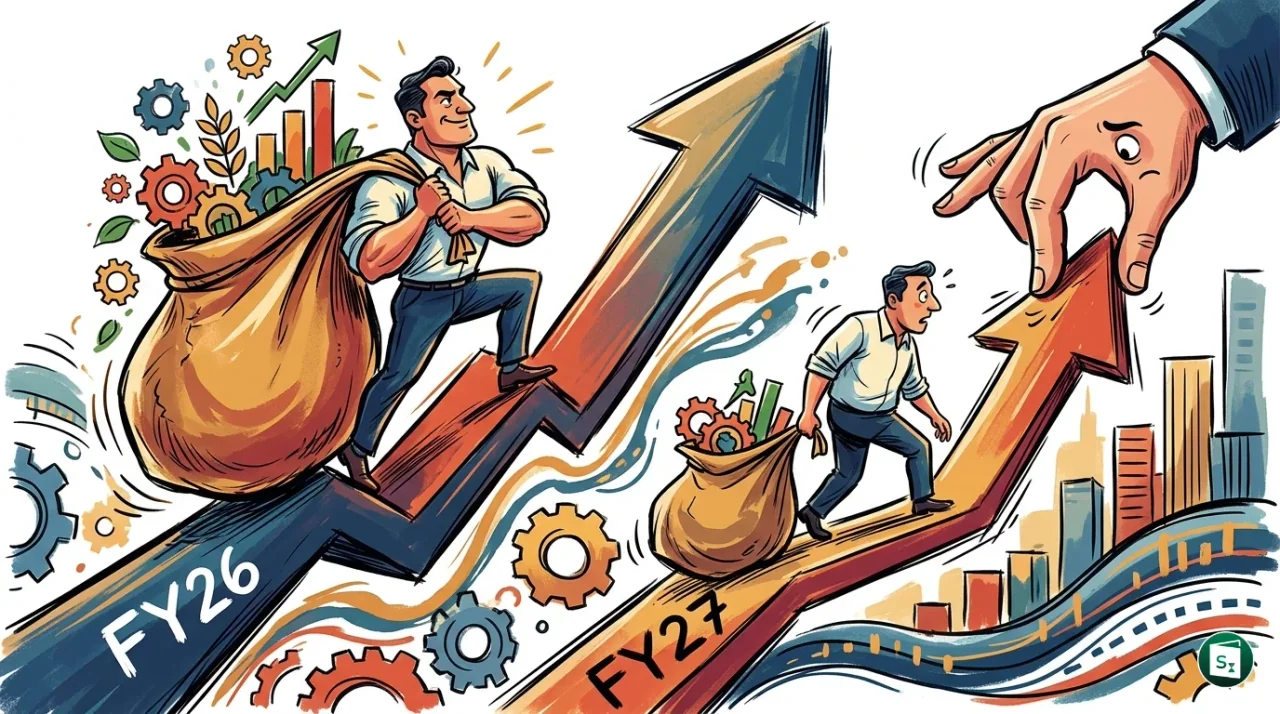
ICRA Limited has lowered its projection for India’s real Gross Domestic Product (GDP) growth for the fiscal year 2026 to 2027 to 6.2 percent, a decrease from its earlier estimate of 6.5 percent. This downward revision of 30 basis points comes amid expectations of a moderate slowdown in investment activity and persistent global economic uncertainties. While the current fiscal year 2025 to 2026 remains on a strong footing with a 7.5 percent growth projection, the agency highlights emerging challenges that may impact the momentum in the following year.
ICRA Cuts India’s Growth Outlook for FY27
The Investment Information and Credit Rating Agency of India Limited, popularly known as ICRA, has adjusted its forecast for India’s economic performance for the upcoming fiscal year. A basis point is a standard unit of measure for interest rates and other percentages in finance, where one basis point is equal to one hundredth of one percent. Therefore, a 30 basis points reduction signifies a decrease of 0.3 percentage points in the projected growth rate.
This revision reflects a shift in the domestic and international economic landscape. For the financial year 2025 to 2026, ICRA maintains a robust outlook with an estimated growth rate of 7.5 percent. However, the moderation to 6.2 percent for financial year 2026 to 2027 suggests that the record levels of expansion seen in the previous quarters may face a period of normalization. The National Statistical Office (NSO), which operates under the Ministry of Statistics and Programme Implementation, is the primary body responsible for releasing official national accounts data in India.
Drivers of the Downward Revision
The adjustment in India’s growth trajectory is attributed to a combination of external pressures and a recalibration of internal demand. Analysts suggest that the high base effect of previous years, coupled with rising global volatility, necessitates a more cautious outlook.
Global Headwinds and Trade Volatility
One of the primary factors weighing on India’s growth is the unstable international trade environment. The escalation of conflicts in West Asia has resulted in increased global energy prices and logistical disruptions. Furthermore, changes in global trade policies, such as the introduction of reciprocal tariffs by major economies like the United States, have created headwinds for India’s merchandise exports. These external shocks increase the Current Account Deficit and put pressure on the domestic currency, thereby impacting overall economic stability.
Domestic Consumption and Investment Trends
Domestically, the agency observes a transition in the investment cycle. For several years, government led capital expenditure has been the primary engine of growth. However, there is now a cooling period as the private sector adopts a cautious approach toward new investments. High interest rates, currently maintained by the Reserve Bank of India (RBI) at a neutral stance, have also contributed to a slowdown in private consumption. While rural demand has shown signs of recovery due to favorable monsoons, it is not yet sufficient to offset the moderation in urban industrial activity.
Comparing Projections for the Indian Economy
ICRA’s revised estimate of 6.2 percent for financial year 2026 to 2027 is notably more conservative than the projections provided by other major institutions. For instance, the Reserve Bank of India (RBI) has projected a growth rate of 6.9 percent for the same period. This discrepancy highlights the varying assessments of how global shocks and domestic consumption patterns will play out in the coming quarters.
| Institution | FY26 Growth Estimate | FY27 Growth Estimate |
|---|---|---|
| ICRA Ltd | 7.5 percent | 6.2 percent |
| Reserve Bank of India (RBI) | 7.6 percent | 6.9 percent |
| World Bank (General Outlook) | 7.2 percent | 6.5 percent |
The comparison suggests that while the financial year 2025 to 2026 is expected to be a period of peak performance, the following year will likely see a transition toward a more sustainable, albeit slower, growth rate.
The Role of ICRA in India’s Financial Landscape
Founded in 1991, ICRA Limited was established as a joint venture between Moody’s and several prominent Indian financial institutions. It was originally known as the Investment Information and Credit Rating Agency of India Limited. Over the decades, it has evolved into a premier independent credit rating agency, providing analytical data that helps investors and policymakers navigate the Indian market.
Headquartered in Gurugram, Haryana, ICRA is now majority owned by Moody’s Corporation, which holds more than 51 percent of its shares. The agency plays a critical role in assigning credit ratings to debt instruments, conducting economic research, and providing corporate governance services. Its assessments are closely watched as they provide an independent perspective on the health of the Indian economy and the creditworthiness of various entities.
Key Takeaways
- ICRA has revised India’s GDP growth forecast for the financial year 2026 to 2027 downward to 6.2 percent.
- The growth projection for the current financial year 2025 to 2026 remains steady at 7.5 percent.
- The downward revision of 30 basis points is primarily due to global trade volatility and a cautious private investment climate.
- ICRA Limited, founded in 1991, is a leading credit rating agency majority owned by Moody’s Corporation.
- The National Statistical Office (NSO) is the nodal agency in India responsible for releasing official GDP data.
- The Reserve Bank of India (RBI) currently projects a higher growth rate of 6.9 percent for the fiscal year 2027.