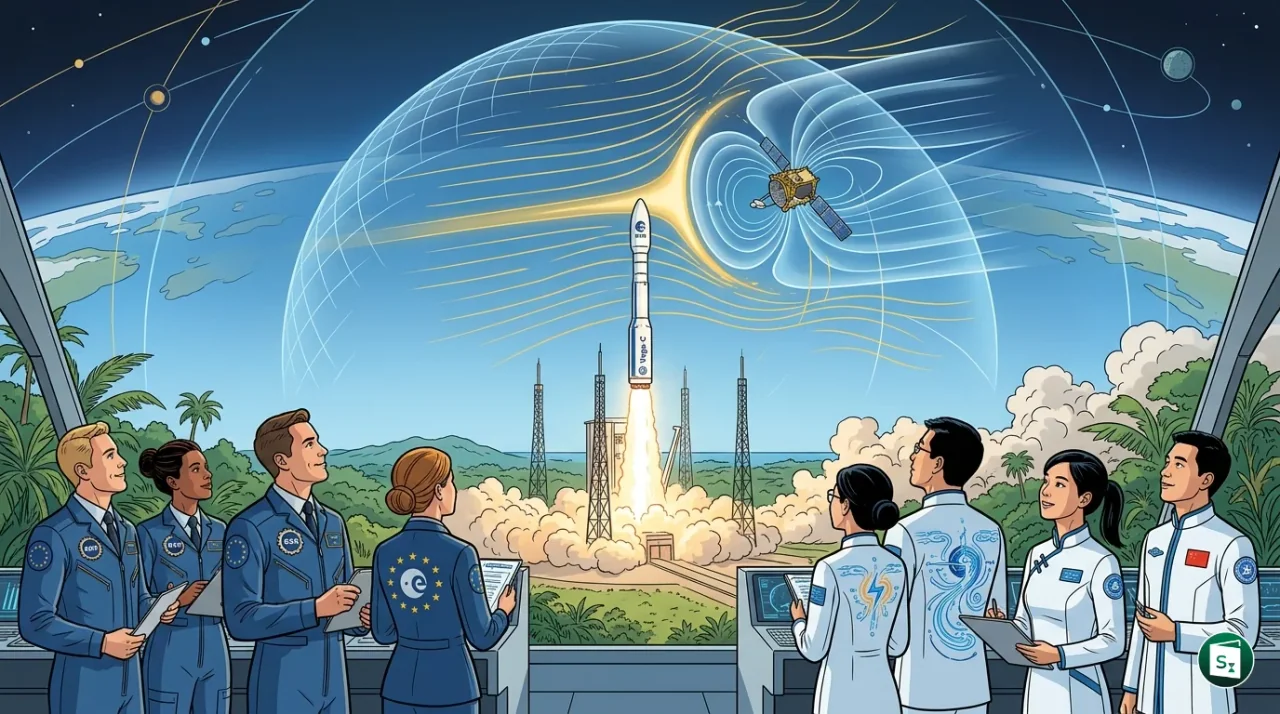
The European Space Agency (ESA) and the Chinese Academy of Sciences (CAS) successfully launched the Solar wind Magnetosphere Ionosphere Link Explorer (SMILE) mission on May 19, 2026, from the Kourou Spaceport in French Guiana. Carried by the Vega-C rocket, this joint spacecraft is designed to capture the first-ever global, panoramic X-ray images of Earth’s magnetic shield to observe how it reacts to the constant stream of particles from the Sun. By mapping the interaction between solar wind and the magnetosphere, the three-year mission will significantly enhance our ability to predict and prepare for destructive geomagnetic storms.
What is the SMILE Mission?
The Solar wind Magnetosphere Ionosphere Link Explorer (SMILE) is a landmark scientific mission representing a fully integrated partnership between the European Space Agency (ESA) and the Chinese Academy of Sciences (CAS). Unlike many international projects where partners contribute isolated components, SMILE was jointly selected and designed from its inception. The mission is tasked with observing the Earth’s magnetosphere, the invisible bubble of magnetic force that protects our planet from harmful solar radiation, in a way that has never been done before.
The spacecraft was launched from the Guiana Space Centre in Kourou, French Guiana, onboard a Vega-C rocket. Following its launch, the spacecraft began a month-long journey to a highly elliptical orbit that will take it as far as 121,000 kilometres from Earth. This high-altitude vantage point allows the satellite to look back and capture a panoramic view of the entire magnetosphere for extended periods. The European Space Agency, headquartered in Paris, France, and the Chinese Academy of Sciences, based in Beijing, have committed to a primary mission duration of three years.
| Feature | Details |
|---|---|
| Nodal Agencies | ESA and CAS |
| Launch Vehicle | Vega-C (Flight VV29) |
| Launch Site | Kourou Spaceport, French Guiana |
| Mission Duration | 3 Years (Primary Phase) |
| Operational Orbit | Highly Elliptical (Apogee ~121,000 km) |
The Science of Solar Wind and Earth’s Shield
The Sun constantly emits a stream of charged particles known as the solar wind. While Earth is protected by its magnetic field, the interaction between these particles and the magnetosphere is dynamic and sometimes violent. When the solar wind intensifies, it can cause the magnetosphere to compress or vibrate, leading to geomagnetic storms. These events can drive energy deep into Earth’s atmosphere, creating beautiful auroras but also posing severe threats to modern technology.
Historically, most space missions have studied these phenomena using “in-situ” measurements, where satellites measure particles only at their specific location in space. This is similar to trying to understand a massive storm by looking at a single rain gauge. The SMILE mission changes this by providing an “outside-in” view. By orbiting far above the North Pole, it can capture global images of the magnetopause, the boundary where the solar wind meets Earth’s magnetic field, allowing scientists to see the entire system’s reaction in real-time.
Analogy · The Magnetic Umbrella Expand analogy
Imagine Earth as a person standing in a heavy rainstorm holding an invisible umbrella. Previous missions were like small sensors on the umbrella’s surface that could only tell you where individual drops were hitting. The SMILE mission is like a camera on a nearby building that can see the whole umbrella, showing exactly how it bends and shakes as the wind and rain change.
Advanced Instrumentation for Global Observation
The SMILE spacecraft is equipped with four sophisticated instruments that work in tandem to provide a comprehensive picture of the Sun-Earth connection. These instruments combine remote sensing (taking pictures from a distance) and in-situ measurements (analysing the environment directly around the satellite).
| Instrument | Developer | Primary Function |
|---|---|---|
| Soft X-ray Imager (SXI) | ESA / United Kingdom | Captures X-ray emissions produced when solar wind particles collide with Earth’s atmosphere, providing the first-ever global images of the magnetopause. |
| Ultraviolet Imager (UVI) | CAS / China | Monitors the global distribution of the auroras (northern lights) to track how energy from the solar wind is deposited into the upper atmosphere. |
| Light Ion Analyser (LIA) | CAS / China | Measures the density, velocity, and temperature of the solar wind and plasma surrounding the spacecraft. |
| Magnetometer (MAG) | CAS / China | Measures the local magnetic field to detect changes and waves caused by solar activity. |
By combining the wide-angle “big picture” from the SXI and UVI with the precise local data from the LIA and MAG, scientists can build a complete model of how solar storms develop. This multi-layered approach is essential for understanding the substorm cycle, the process by which energy is stored and suddenly released in the Earth’s magnetic tail.
Protecting Global Infrastructure from Solar Storms
The primary goal of the SMILE mission is to safeguard the critical infrastructure that underpins modern society. Solar activity and the resulting geomagnetic storms can have devastating effects across multiple sectors. High-energy particles from the Sun can heat the Earth’s upper atmosphere, causing it to expand. This expansion increases atmospheric drag on low-Earth orbit satellites, potentially causing them to drop in altitude and burn up.
Solar storms can also induce powerful electrical currents in the ground, known as Geomagnetically Induced Currents (GICs). These currents can flow through high-voltage power lines, saturating transformer cores and leading to massive blackouts or permanent equipment damage. Aviation is also at risk, as radiation levels at high altitudes can spike during solar events, and GPS signals can be distorted, affecting everything from maritime navigation to financial transactions. By providing earlier and more accurate warnings, SMILE gives power grid operators and satellite controllers the time needed to take protective actions, such as placing spacecraft in “safe mode” or reconfiguring electrical networks.
Key Takeaways
- The SMILE mission stands for Solar wind Magnetosphere Ionosphere Link Explorer and is a joint venture between the European Space Agency (ESA) and the Chinese Academy of Sciences (CAS).
- The spacecraft was successfully launched on May 19, 2026, from the Guiana Space Centre in Kourou, French Guiana, using a Vega-C rocket.
- The primary goal of the mission is to capture the first-ever global X-ray images of the magnetosphere, Earth’s invisible magnetic shield against solar radiation.
- The mission is equipped with four key instruments, including the Soft X-ray Imager (SXI) and the Ultraviolet Imager (UVI), to provide simultaneous global and local data.
- Following a three-month commissioning phase, routine scientific observations are expected to begin in September 2026.
- The three-year mission will improve early warning systems for geomagnetic storms, helping to protect global power grids, satellites, and communication networks.