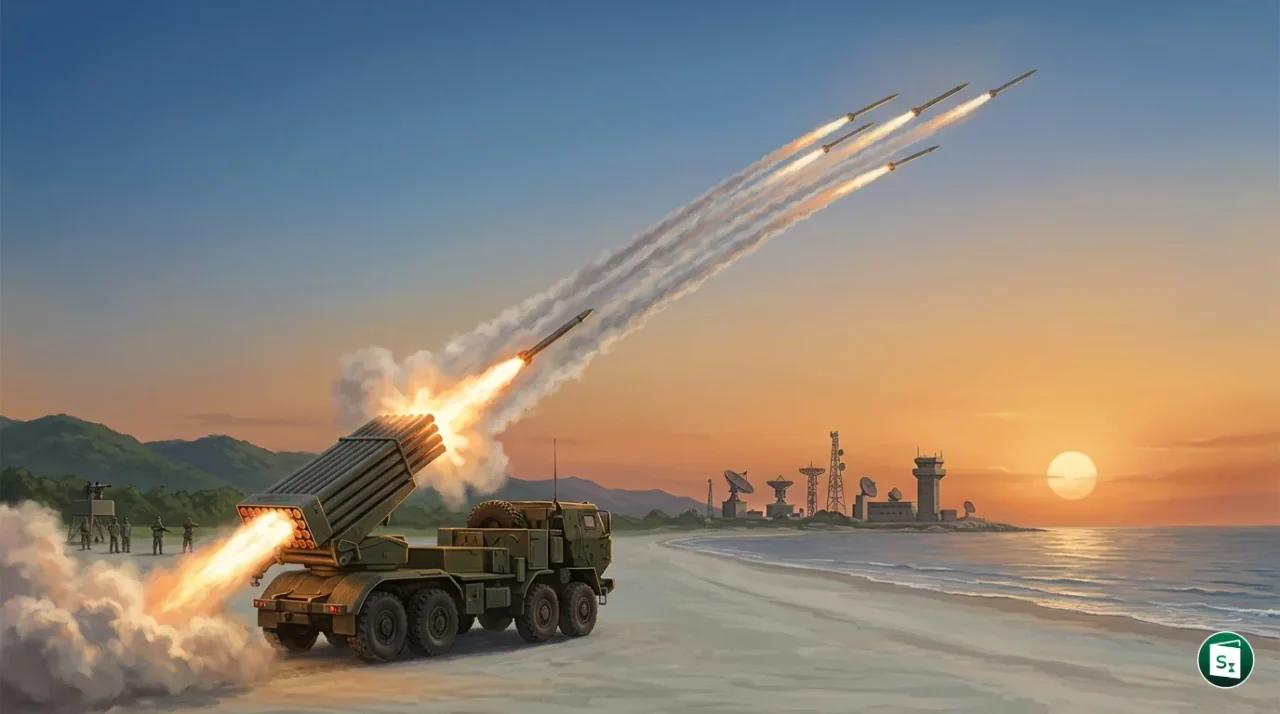
India conducted consecutive successful trials of the Suryastra Universal Rocket Launcher system at the Integrated Test Range in Chandipur, Odisha, on May 25, 2026. This advanced system, developed through a partnership between Pune-based NIBE Limited and Israel’s Elbit Systems, demonstrated exceptional precision in both its tactical and strategic variants. These trials mark a significant step in the indigenisation of high-range artillery for the Indian Army.
What Is the Suryastra Universal Rocket Launcher?
The Suryastra is a high-precision, multi-caliber rocket launcher system designed to provide long-range fire support on the battlefield. Unlike traditional fixed-caliber launchers, the Universal Rocket Launcher architecture allows it to fire a variety of rockets and missiles with minimal reconfiguration. This flexibility makes it a versatile asset for the Indian Army, enabling it to engage different types of targets depending on the operational requirement.
The system is available in two distinct configurations: the Tactical Variant and the Strategic Variant. The tactical version is intended for immediate battlefield support, while the strategic version offers extended reach for deep-strike missions. By integrating advanced navigation and guidance systems, the Suryastra ensures that it can neutralize targets with minimal collateral damage, even at extreme ranges. This development is part of India’s broader push to involve the private sector in defence manufacturing, specifically through Pune-based NIBE Limited.
Technical Specifications: Precision and Range
The Suryastra system stands out for its combination of long reach and pinpoint accuracy. During the trials at the Integrated Test Range (ITR), both variants met their performance benchmarks. Accuracy in such systems is measured by Circular Error Probable (CEP), which indicates the radius of a circle within which 50% of the rounds are expected to land. A lower CEP value signifies higher precision.
| Feature | Tactical Variant | Strategic Variant |
|---|---|---|
| Maximum Range | 150 km | 300 km |
| CEP (Precision) | 1.5 metres | 2.0 metres |
| Primary Use | Battlefield Support | Deep-Strike Missions |
The Tactical Variant, with a range of 150 km, achieved a CEP of 1.5 m. This level of precision is virtually unheard of for conventional rocket artillery at such distances. The Strategic Variant, capable of hitting targets at 300 km, maintained a CEP of 2.0 m, ensuring that high-value assets deep within enemy territory can be targeted with surgical accuracy. This precision reduces the number of rockets required to destroy a target, thereby improving logistical efficiency.
Strategic Partnership: NIBE Ltd and Elbit Systems
The development of the Suryastra is a testament to the growing role of the private sector in India’s defence ecosystem. NIBE Limited, headquartered in Pune, has collaborated with Elbit Systems, one of Israel’s largest defence electronics companies. This partnership brings together Elbit’s world-class expertise in precision-guided munitions and NIBE’s robust manufacturing capabilities in India.
This collaboration aligns with the Atmanirbhar Bharat (Self-Reliant India) initiative, which encourages the domestic production of critical defence equipment. By manufacturing the system in India, NIBE ensures that the Indian Army has a reliable supply chain and access to local maintenance and support. Furthermore, the transfer of technology from Israel strengthens India’s internal research and development capabilities in the field of advanced artillery.
India and Israel have a long-standing defence relationship, with Israel being one of India’s top suppliers of military technology. This partnership has previously yielded several successful projects, including the Barak-8 surface-to-air missile system and various unmanned aerial vehicles. The Suryastra project further cements this strategic bond, focusing on the next generation of precision-strike weapons.
The Role of Emergency Procurement in Indian Defence
The acquisition of the Suryastra system was facilitated through the Emergency Procurement (EP) window, a fast-track mechanism designed to bypass the standard, often lengthy, acquisition process. Under this window, the Ministry of Defence delegates financial powers to the Vice Chiefs of the three services (Army, Navy, and Air Force) to procure equipment that addresses immediate operational requirements.
The Indian Army placed an order worth ₹293 crore for the Suryastra system to quickly enhance its artillery capabilities. Emergency procurement powers were significantly expanded following the border tensions in 2020, allowing the services to acquire critical technologies and ammunition within a shorter timeframe, typically within a year. This ensures that the armed forces remain combat-ready and equipped with the latest technology to counter evolving threats.
The Defence Acquisition Council (DAC), which is the highest decision-making body on defence procurement and is headed by the Union Defence Minister, oversees the broader policy framework. However, the EP window provides the agility needed to respond to urgent security challenges, such as the need for long-range, high-precision artillery on India’s northern and western borders.
Enhancing India’s Artillery Power
The induction of the Suryastra system is a major boost for the Indian Army’s Artillery Modernization Plan. Historically, India has relied on systems like the Russian Smerch, which has a range of approximately 90 km, and the indigenous Pinaka Multi-Barrel Rocket Launcher (MBRL). While the Pinaka, developed by the Defence Research and Development Organisation (DRDO), has been highly successful with ranges between 40 km and 75 km (and extended versions reaching 120 km), the Suryastra offers a significant leap in both range and precision.
By providing ranges of 150 km and 300 km, the Suryastra system bridges the gap between traditional rocket artillery and short-range ballistic missiles like the Pralay, which has a range of 150 km to 500 km. This creates a layered strike capability, allowing the Army to choose the most cost-effective and precise tool for any given distance.
The successful consecutive trials at Chandipur confirm that the system is ready for induction. As these units are deployed, they will provide India with a formidable deterrent, capable of neutralizing high-value targets with extreme precision from safe distances. This development not only enhances national security but also serves as a model for future collaborations between the Indian private sector and global defence leaders.
Key Takeaways
- India successfully conducted trials of the Suryastra Universal Rocket Launcher system from the Integrated Test Range (ITR) in Chandipur, Odisha, on May 25, 2026.
- The system was developed through a strategic partnership between Pune-based NIBE Limited and Israel’s Elbit Systems.
- The Tactical Variant of the Suryastra has a range of 150 km with a precision of 1.5 metres, while the Strategic Variant reaches 300 km with a precision of 2.0 metres.
- The Indian Army placed a ₹293 crore order for the system under the Emergency Procurement (EP) window to fill critical operational gaps.
- The Suryastra system bridges the gap between the indigenous Pinaka MBRL and short-range ballistic missiles like the Pralay.
- The development aligns with the Atmanirbhar Bharat initiative by involving the Indian private sector in high-tech defence manufacturing.