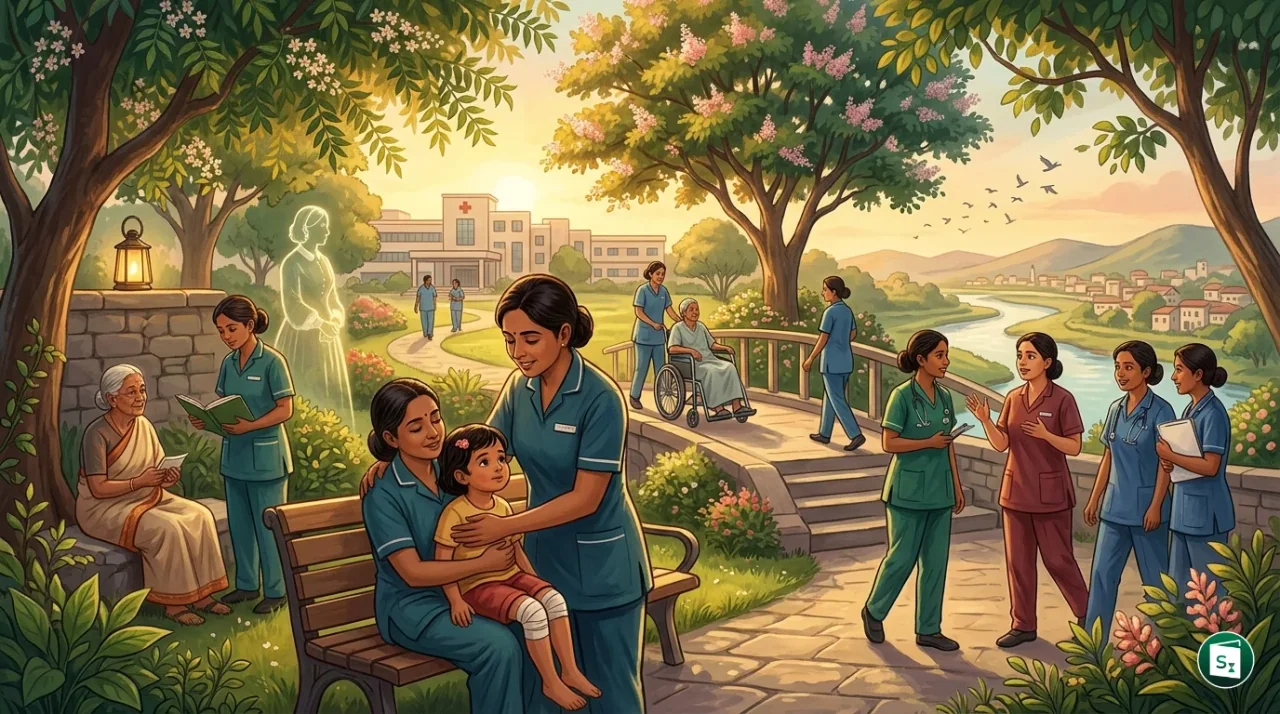
International Nurses Day is observed globally on May 12 to honor the tireless contributions of nursing professionals and commemorate the birth anniversary of Florence Nightingale. The 2026 observance, themed Our Nurses. Our Future. Empowered Nurses Save Lives, emphasizes the critical need to invest in nursing education and leadership to ensure resilient healthcare systems. This day serves as a reminder that nurses are not just caregivers but the foundational strength of medical services across the world.
The Legacy of Florence Nightingale
The choice of May 12 is deeply symbolic as it marks the birth of Florence Nightingale (1820–1910), the English social reformer widely celebrated as the founder of modern nursing. Known as The Lady with the Lamp, she gained fame for her pioneering work during the Crimean War, where she managed the care of wounded soldiers and significantly reduced death rates through improved hygiene and sanitation.
Nightingale’s contributions went beyond the battlefield. In 1860, she established the Nightingale Training School at St. Thomas’ Hospital in London, the first secular nursing school in the world. Her book, Notes on Nursing, remains a foundational text in the profession. She was also a talented statistician, using data visualization like the coxcomb chart to advocate for healthcare reforms. Her legacy continues to inspire the profession’s commitment to evidence-based care and patient advocacy.
The International Council of Nurses (ICN)
The International Council of Nurses (ICN) is the global body responsible for coordinating International Nurses Day. Established in 1899, the ICN is a federation of more than 130 national nurses associations, representing over 28 million nurses worldwide. It is headquartered in Geneva, Switzerland, having moved there from London in 1965 to work closely with the World Health Organization (WHO).
The ICN serves as the voice of nursing globally, working to ensure quality nursing care for all and sound health policies. Each year, the ICN chooses a theme to focus on specific challenges facing the profession. The 2026 theme, Our Nurses. Our Future. Empowered Nurses Save Lives, calls for legislative and financial support to empower nurses, allowing them to work to the full extent of their education and training.
Strengthening Nursing Infrastructure in India
In India, the nursing profession is undergoing a significant transformation aimed at bridging the gap between demand and supply. According to the WHO State of the World’s Nursing (SoWN) 2025 report, India has approximately 1.9 nurses per 1,000 people, which is below the WHO recommendation of 3 nurses per 1,000. To address this, the government has launched several large-scale initiatives.
The National Nursing and Midwifery Commission (NNMC) Act
The implementation of the National Nursing and Midwifery Commission (NNMC) Act, 2023, marks a paradigm shift in nursing regulation. It replaces the Indian Nursing Council Act, 1947, which governed the profession for over seven decades. The NNMC aims to:
- Decentralize Governance: Establishing autonomous boards at the national level for education, ethics, and registration.
- Uniform Standards: Moving toward a Common Entrance Exam and potentially a national exit exam to ensure a high quality of nursing graduates.
- Digital Tracking: Utilizing the Nurses Registration and Tracking System (NRTS), an Aadhaar-linked live register to prevent data duplication and track the active workforce.
Expansion of Nursing Colleges
To tackle the shortage of qualified personnel, the government is establishing 157 new government nursing colleges. These colleges are co-located with existing medical colleges established since 2014. This initiative is expected to add approximately 15,700 nursing seats annually, focusing particularly on regions with low nurse-to-population ratios, often referred to as nursing deserts.
| Initiative | Key Feature | Goal |
|---|---|---|
| NNMC Act 2023 | Regulatory Overhaul | Modernize nursing education and practice |
| 157 New Colleges | Infrastructure Expansion | Add 15,700 seats annually |
| NRTS Portal | Digital Workforce Tracking | Maintain a live register of nurses |
| AIIMS NORCET | Centralized Recruitment | Standardize selection for central institutions |
National Florence Nightingale Awards
The National Florence Nightingale Award is the highest national recognition for nursing professionals in India. Instituted by the Ministry of Health and Family Welfare (MoHFW) in 1973, the award honors nurses who have rendered meritorious services to society with commitment and selfless dedication.
The awards are traditionally presented by the President of India at Rashtrapati Bhavan on May 12 each year. Eligible candidates include Registered Nurses and Midwives, Auxiliary Nurses and Midwives (ANM), and Lady Health Visitors (LHV) from across the central, state, and private sectors. The award currently comprises a cash prize of ₹1,00,000, a certificate of merit, and a medal. These awards serve to boost the morale of nursing personnel and acknowledge their indispensable role in the national healthcare delivery system.
Key Takeaways
- International Nurses Day is celebrated annually on May 12 to mark the birth anniversary of Florence Nightingale, the founder of modern nursing.
- The theme for 2026 is Our Nurses. Our Future. Empowered Nurses Save Lives, focusing on the empowerment and professional growth of nurses.
- The International Council of Nurses (ICN), established in 1899 and headquartered in Geneva, coordinates the global observance of the day.
- India is transitioning from the Indian Nursing Council to the National Nursing and Midwifery Commission (NNMC) under the NNMC Act, 2023.
- The Government of India is establishing 157 new nursing colleges to add approximately 15,700 seats annually to the nursing workforce.
- The National Florence Nightingale Awards, instituted in 1973, are presented by the President of India to honor outstanding nursing service.