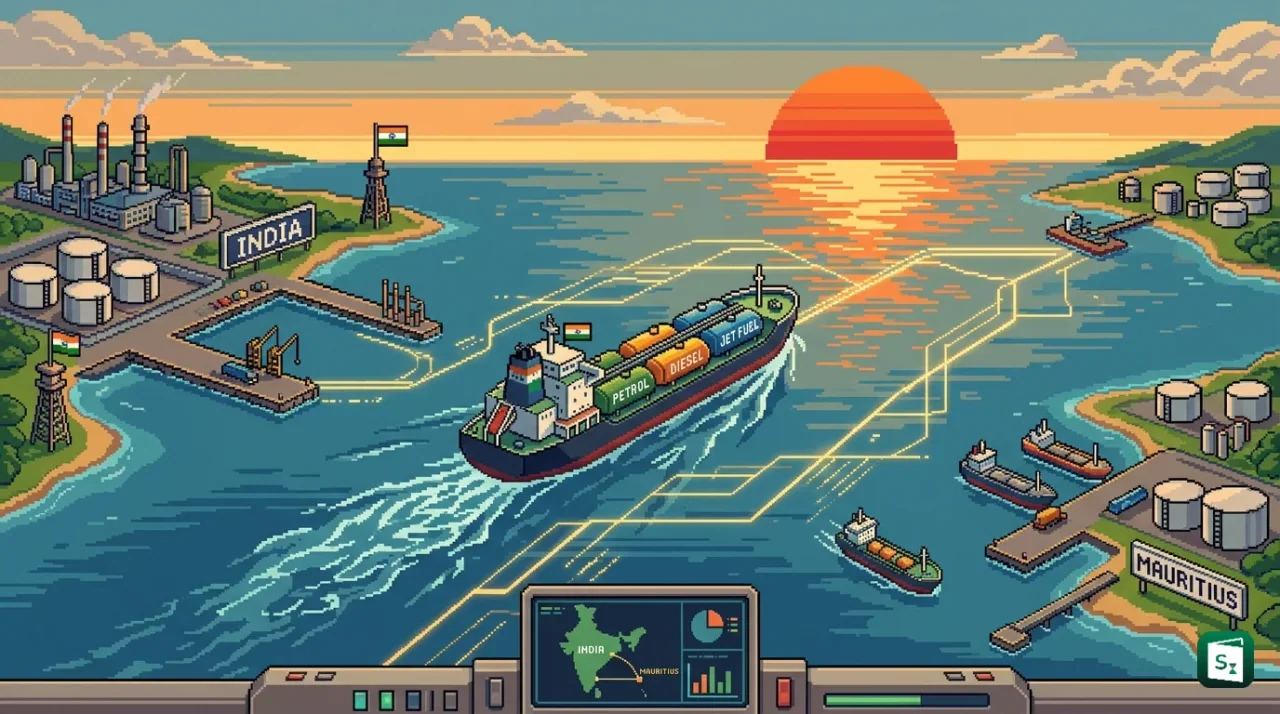
India and Mauritius have signed a landmark energy partnership on 20 to 21 August 2026 in Port Louis, with a Government-to-Government (G2G) Memorandum of Understanding (MoU) on oil and gas cooperation and a parallel five-year deal for assured fuel supply. Union Minister of Petroleum and Natural Gas Hardeep Singh Puri exchanged the agreements in the presence of Mauritius Prime Minister Navinchandra Ramgoolam. Under the commercial leg, Indian Oil Corporation Limited (IOCL) will meet the island nation’s entire import requirement of petrol, diesel and jet fuel, marking India’s first long-term supply agreement by a public sector oil company outside South Asia in recent years.
What Was Signed During Hardeep Puri’s Visit?
Two distinct but linked instruments were exchanged during Petroleum and Natural Gas Minister Hardeep Singh Puri’s official visit to Mauritius on 20 and 21 August 2026.
The first was a Government-to-Government (G2G) Memorandum of Understanding (MoU) on cooperation in the oil and gas sector. A MoU is a formal framework that sets out how two governments will work together, but it is not a commercial sales contract by itself. This G2G MoU was signed between the Ministry of Petroleum and Natural Gas, Government of India, and the Ministry of Commerce and Consumer Protection, Government of Mauritius. On the Mauritian side, the signatory was Minister John Michael Tzoun Sao Yeung Sik Yuen.
The second was a five-year Sales and Purchase Agreement between Indian Oil Corporation Limited (IOCL) and the State Trading Corporation (STC) of Mauritius. This is the commercial contract that actually governs the supply, pricing and delivery of fuel. It was witnessed by Minister Puri and Prime Minister Navinchandra Ramgoolam, who met Puri on 20 August in Port Louis.
The two agreements together create a full stack partnership, a government framework plus a company-level supply contract. The government has not disclosed detailed commercial terms such as exact volumes or pricing formula, but it has confirmed the duration, products and broad objectives.
Understanding the Two Agreements
1. Government-to-Government MoU on Oil and Gas
A Government-to-Government agreement means the deal is signed directly between two sovereign governments rather than between private companies. Such pacts provide policy backing, simplify approvals and give long-term stability to the partnership.
The G2G MoU on oil and gas cooperation institutionalises what has so far been a series of ad-hoc fuel shipments and buyer-seller transactions. Its scope covers three broad areas. First, cooperation in petroleum products supply, which provides the government umbrella for the IOCL-STC sales contract and any future supply arrangements. Second, training and capacity building, where India will train Mauritian officials in procurement, quality control and petroleum management. Third, cooperation in biofuels, through exchange of knowledge, joint research and training.
The biofuels element is significant. Mauritius is a founding member of the Global Biofuels Alliance (GBA), which was launched by India during its G20 Presidency in 2023. The GBA Secretariat has been working with the Mauritian Ministry of Energy and Public Utilities to develop a Biofuels Country Landscape Policy Framework for Mauritius, a diagnostic report that maps the potential for ethanol, biodiesel and other biofuels in the country’s energy mix. The MoU gives this work a formal home.
2. Five-Year Sales and Purchase Agreement Between IOCL and STC
The commercial agreement is between IOCL on the Indian side and the State Trading Corporation (STC) on the Mauritian side. STC is a parastatal body fully owned by the Government of Mauritius, established under the STC Act of 1982 and functioning under the Ministry of Commerce and Consumer Protection. It is the sole importer of petroleum products for Mauritius’ inland needs, as well as the importer of LPG, rice and flour.
Under the pact, IOCL will supply the entire import requirement of Mauritius for Motor Spirit (MS or petrol), High Speed Diesel (HSD or diesel) and Aviation Turbine Fuel (ATF or jet fuel) for five years. The agreement also covers Marine Gas Oil in some official references. The petroleum will be delivered on a long-term basis, which helps Mauritius secure assured supply and shield itself from price volatility in global oil markets.
For IOCL, this is a strategic first. The Ministry of Petroleum and Natural Gas said it is the first long-term supply agreement concluded by an Indian public sector oil marketing company outside South Asia in recent years. India already meets the entire petroleum demand of Nepal and Bhutan on similar long-term arrangements, and the Mauritius deal extends that model into the Indian Ocean beyond the subcontinent. IOCL already has a footprint in Mauritius through its wholly owned subsidiary IndianOil (Mauritius) Ltd (IOML), which has operated since 2004 in aviation fueling, retail distribution and bunkering, and runs a 33,305 metric tonne capacity terminal at Mer Rouge, Port Louis.
Alongside the supply pact, Minister Puri jointly broke ground with Mauritian counterparts for a new 27,500 metric tonne (27.5 TMT) bunker marine fuel storage facility at Mer Rouge in Port Louis Harbour, to be built by IOML. The $25 million facility will augment storage for Very Low Sulphur Fuel Oil (VLSFO) and Low Sulphur Marine Gas Oil supplied to ships calling at Port Louis, supporting Mauritius’ ambition to become a regional bunkering hub for vessels crossing the Indian Ocean.
Why Mauritius Needs Assured Fuel Supply
Mauritius is a small island nation in the southwestern Indian Ocean, about 2,000 km off the east coast of Africa and east of Madagascar. Its capital is Port Louis. It has a population of about 1.26 million and an Exclusive Economic Zone (EEZ) of about 2.3 million square km, one of the largest in the region. The country has no domestic crude oil or natural gas production and imports 100 percent of its petroleum requirements.
STC imports all petroleum for inland use, including fuel for public transport, industry, private vehicles, power generation by the Central Electricity Board (CEB) and aircraft refuelling at Sir Seewoosagur Ramgoolam (SSR) International Airport. STC then sells the imported fuel to four local oil companies for storage and distribution through about 171 filling stations. These companies are Vivo Energy Mauritius Ltd, TotalEnergies Marketing Mauritius Ltd, Engen Petroleum (Mauritius) Ltd and IndianOil (Mauritius) Ltd.
Total petroleum imports handled by STC have crossed 1.1 million metric tonnes per year, with roughly 800,000 to 850,000 tonnes for inland white oils and the rest for fuel oils used in power generation and bunkering. The indicative annual requirement for white oils is about 210,000 tonnes of petrol, 230,000 tonnes of diesel, 310,000 tonnes of jet fuel and 50,000 tonnes of marine gas oil. STC has traditionally procured these products through open international bidding, which exposes the country to spot market volatility and supply disruptions.
That vulnerability has sharpened against the backdrop of instability in West Asia, a key source region for global refined products. The Mauritian government specifically cited West Asia disruptions as a reason for seeking a stable long-term partner. A fixed five-year arrangement with a large, nearby refiner reduces the risk of sudden shortages or price spikes for an economy heavily dependent on tourism, aviation and shipping.
The deal also fits with Mauritius’ broader energy costs. STC subsidises LPG, rice and flour to keep essential goods affordable, spending about 4.1 billion Mauritian rupees on subsidies in 2023-24. Stable fuel procurement helps contain that fiscal burden.
India’s Energy Strength and Indian Ocean Strategy
For India, the agreement showcases its status as a major refining power and a reliable energy partner in its maritime neighbourhood.
India is the fourth largest refiner in the world and among the top seven exporters of refined petroleum products. Its total installed refining capacity stood at about 258.1 million metric tonnes per annum (MMTPA) as of 1 April 2025, rising to about 267 MMTPA as of 1 April 2026, according to the Petroleum Planning and Analysis Cell (PPAC) under the Ministry of Petroleum and Natural Gas. The country has 23 refineries, including 10 owned by IOCL alone. IOCL, which was formed in 1959 through the merger of Indian Refineries Ltd (1958) and Indian Oil Company, is India’s largest refiner with a capacity of 80.75 MMTPA and a countrywide network of more than 63,000 touchpoints and over 20,000 km of pipelines. With the CPCL Manali (10.5 MMTPA) and other group refineries, the IndianOil group accounts for about 31 percent of national refining capacity.
| Company Group | Key Refineries | Indicative Capacity (MMTPA) |
|---|---|---|
| IOCL | Panipat (15), Paradip (15), Koyali (13.7), Mathura (8), Haldia (8) | 80.75 |
| Reliance Industries | Jamnagar DTA (33) and SEZ (35.2) | 68.2 |
| BPCL | Mumbai (12), Kochi (15.5), Bina (7.8) | 35.3 |
| HPCL | Mumbai (9.5), Visakh (15) | 24.5 |
| Total India | 23 refineries | About 267 as of April 2026 |
Although India imports more than 85 percent of its crude oil, it processes it in large, complex refineries and is a net exporter of refined products such as petrol, diesel and jet fuel. In 2025-26, petroleum product exports were valued at about $44.4 billion, with about 70 percent coming from private refiners like Reliance at Jamnagar, the world’s largest single-location refinery. IOCL is now expanding its own capacity by 17.3 MMTPA across Panipat, Vadodara and Barauni to reach about 98.6 MMTPA by end 2027, which will further increase exportable surplus after meeting domestic demand of about 239 to 242 MMTPA.
That refining surplus underpins energy diplomacy. By becoming the anchor supplier for Mauritius, India extends a model already used with Nepal and Bhutan, strengthens its footprint in the southwestern Indian Ocean, and supports a partner that sits at the junction of major shipping lanes. The investment in bunkering infrastructure at Port Louis Harbour, which handles about 2 million tonnes of petroleum annually with a jetty throughput capacity of about 4 million tonnes, also helps India secure logistical presence in a busy transit corridor.
The agreement also complements India’s push on clean energy cooperation. Beyond conventional fuels, India is helping Mauritius build renewable energy assets, including an 8 MW solar plant at Henrietta and the island’s first floating solar project being developed by an Indian public sector enterprise. Both countries are members of the International Solar Alliance (ISA), headquartered in Gurugram, and the Global Biofuels Alliance.
From SAGAR to MAHASAGAR: The Broader Partnership
The oil and gas pact does not stand alone. It is part of a much deeper and older partnership that was recently elevated during Prime Minister Narendra Modi’s State Visit to Mauritius on 11 to 12 March 2025, when he attended the 57th National Day of Mauritius as Chief Guest.
On that visit, India and Mauritius agreed to elevate ties from a Comprehensive Partnership to an Enhanced Strategic Partnership. The joint vision statement noted that Mauritius sits at the intersection of India’s Neighbourhood First policy, its Vision SAGAR (Security and Growth for All in the Region) unveiled in Mauritius in 2015, and its commitment to the Global South. During the 2025 visit, Modi also unveiled the next iteration of that doctrine, MAHASAGAR (Mutual and Holistic Advancement for Security and Growth Across Regions), for wider cooperation with the Global South through trade, capacity building and maritime security.
Concrete outcomes of that visit included eight MoUs across areas such as maritime traffic monitoring, infrastructure, diplomacy and commerce, the handing over of a navigation chart for St Brandon, the e-inauguration of an Area Health Centre at Cap Malheureux and 20 community development projects, and an announcement of Indian support for a new Parliament building in Mauritius and Phase II of High Impact Community Development Projects.
Energy has been a recurring thread. During External Affairs Minister S. Jaishankar’s visit in April 2025, he indicated that a G2G oil and gas supply agreement was being finalised to reinforce Mauritius’ energy security. The August 2026 agreements deliver on that commitment. Defence and maritime cooperation has also deepened, with India supporting the Mauritius Coast Guard ships Victory, Valiant and Barracuda, providing hydrographic surveys, joint surveillance of the Mauritian EEZ, and assistance for a National Maritime Information Sharing Centre and the development of facilities at Agalega.
For New Delhi, a stable energy link with Port Louis therefore serves three goals at once, commercial outlet for surplus refined products, strategic presence in the Indian Ocean, and development partnership with a key island state that also serves as a gateway to Africa through its membership of the African Continental Free Trade Area (AfCFTA).
The Way Forward
In the near term, IOCL and STC will operationalise the five-year supply schedule, including shipping, quality testing and delivery to the four local oil companies’ storage at the port area and to the airport jet fuel tank. The 27.5 TMT bunker storage facility at Mer Rouge will move from groundbreaking to construction, with consultancy tenders already floated for layout, risk assessment and environmental impact studies.
The G2G MoU creates space to expand beyond the current white oils to other areas such as LPG, fuel oils for power generation, and biofuels blending. Work on the Biofuels Country Landscape Policy Framework for Mauritius is expected to accelerate, giving Mauritian policymakers a roadmap for ethanol blending and import norms. Training programmes for STC and energy ministry personnel in India are also on the agenda.
If implemented smoothly, the arrangement could become a template for similar long-term supply pacts with other Indian Ocean Rim Association (IORA) and Colombo Security Conclave partners, where India chairing IORA in 2025-26 provides a platform to project itself as a dependable energy security provider even as global fuel markets remain volatile.
Key Takeaways
- India and Mauritius exchanged a G2G MoU on oil and gas cooperation and a five-year Sales and Purchase Agreement on 20 to 21 August 2026 in Port Louis during Minister Hardeep Singh Puri’s visit in the presence of PM Navinchandra Ramgoolam.
- Under the deal, IOCL will supply the entire import requirement of Mauritius for petrol (MS), diesel (HSD) and jet fuel (ATF) through the State Trading Corporation (STC), Mauritius’ sole fuel importer set up under the STC Act, 1982.
- It is the first long-term supply agreement by an Indian PSU oil marketing company outside South Asia in recent years, extending a model already used for Nepal and Bhutan.
- The G2G MoU covers petroleum supply, training and capacity building, and biofuels cooperation, with Mauritius being a founding member of the Global Biofuels Alliance launched during India’s G20 Presidency in 2023.
- India’s refining capacity of about 267 MMTPA across 23 refineries makes it the world’s fourth largest refiner and a net exporter of petrol, diesel and jet fuel, while IOCL alone holds 80.75 MMTPA from 10 refineries and was founded in 1959.
- A 27.5 TMT bunker marine fuel storage facility at Mer Rouge, Port Louis by IndianOil (Mauritius) Ltd (operating since 2004) was also initiated to strengthen Mauritius as an Indian Ocean bunkering hub.