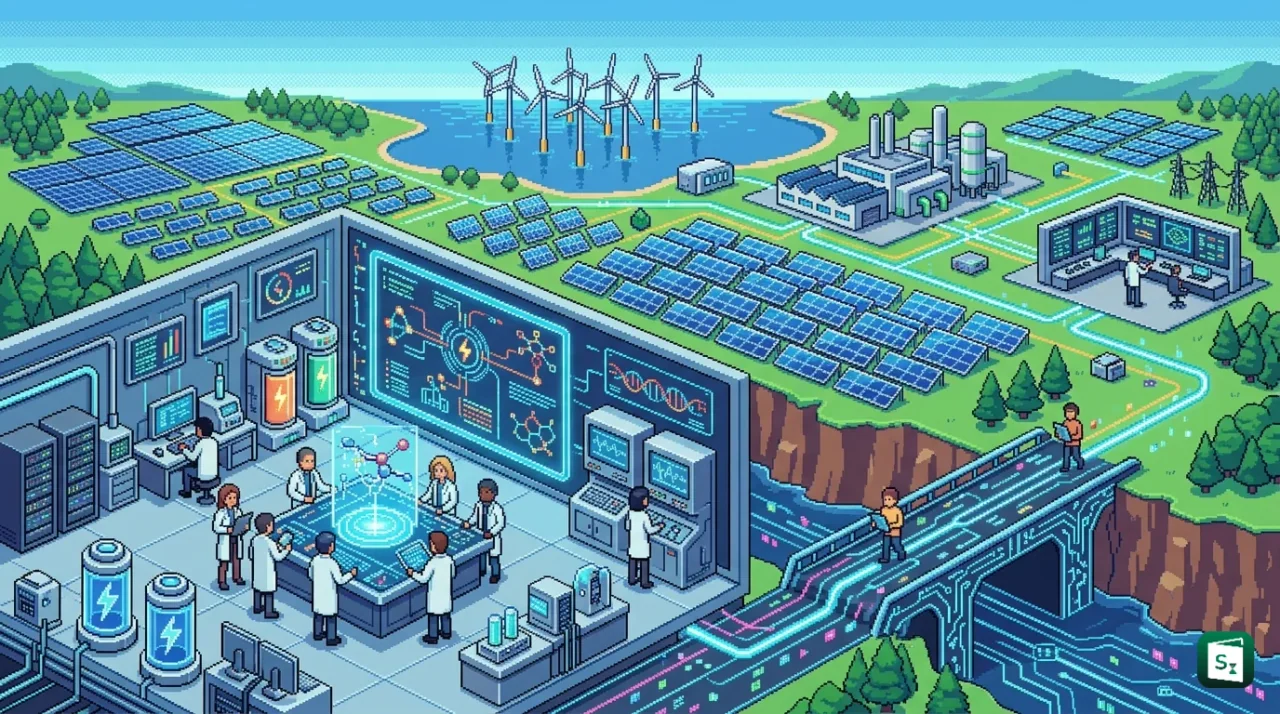
Tata Power Company Limited has signed a Master Research Agreement (MRA) with the Indian Institute of Technology Bombay (IIT Bombay) to speed up the development, scaling and commercialisation of next generation energy technologies. The long term partnership was formalised at the IIT Bombay campus in Powai, Mumbai, and brings the country’s largest integrated private power utility together with one of its premier engineering institutes. It aims to turn laboratory scale innovations into market ready clean energy solutions for India’s power sector.
What Exactly Was Signed
The Master Research Agreement was signed on 17 August 2026 at IIT Bombay by Dr Praveer Sinha, Chief Executive Officer and Managing Director of Tata Power, and Prof Shrikrishna V Kulkarni, Dean of Research and Development at IIT Bombay, in the presence of Prof Shireesh Kedare, Director, IIT Bombay.
A Master Research Agreement is a framework pact that sets common terms for multiple joint research projects over several years. Instead of negotiating a separate contract for each idea, the two partners agree once on intellectual property sharing, funding, confidentiality and commercialisation rules. After that, individual projects can be added quickly under the umbrella. This structure is designed to move ideas from lab to pilot to scale without repeated legal delays.
The statement from both sides described the MRA as the start of a long term strategic partnership to accelerate, scale and commercialise lab scale innovations in advanced clean energy. The focus is not only on discovery but on translation, or turning cutting edge research into scalable, industry ready technologies that can be deployed on the grid, in factories and in homes.
Nine Technology Areas Under the Partnership
The collaboration will jointly develop solutions across nine priority domains. Each addresses a bottleneck in India’s ongoing shift from fossil fuels to cleaner electricity.
| Technology Area | What It Means in Simple Terms | Why It Matters for India |
|---|---|---|
| Smart Grids | Electricity networks that use sensors and software to balance supply and demand in real time | Helps handle variable solar and wind power and reduces outages |
| Power Electronics | Devices that control and convert electric power efficiently, such as inverters and converters | Improves efficiency of solar plants, EV chargers and grid equipment |
| Energy Storage | Batteries and other systems that store electricity for later use | Stores daytime solar power for evening demand and provides backup |
| Electric Mobility | Technologies for electric vehicles, charging infrastructure and vehicle to grid systems | Supports India’s EV push and cuts oil imports |
| AI for Power Systems | Artificial Intelligence tools to forecast demand, predict faults and optimise operations | Makes grid management faster, cheaper and more reliable |
| Digital Grid Technologies | Digital platforms for monitoring, billing, automation and consumer services | Enables smart meters, digital payments and transparent distribution |
| Cybersecurity | Protection of power control systems from hacking and data theft | Critical as grids become more digital and connected |
| Carbon Capture | Technologies that trap carbon dioxide from industrial or power sources | Helps decarbonise hard to abate sectors while meeting climate goals |
| Circular Economy | Reuse, recycling and resource efficient design for energy equipment | Reduces waste from batteries, solar panels and electronic components |
Together, these areas cover generation, transmission, distribution, storage and end use. The inclusion of cybersecurity and AI signals that the partnership sees the future grid as both physical and digital, where software is as important as wires and turbines. The circular economy angle is also notable, as India will soon face large volumes of used solar modules and lithium batteries that need safe recycling.
The Two Partners: Who They Are
Tata Power Company Limited
Tata Power, headquartered in Mumbai, is part of the Tata Group and is described as India’s largest integrated power company. It was incorporated as the Tata Hydroelectric Power Supply Company in 1911 and consolidated as The Tata Power Company Limited on 18 September 1919. Its early hydro projects at Khopoli (1915), Bhivpuri (1919) and Bhira (1927) in the Western Ghats brought hydroelectricity to Bombay’s mills and set the template for private integrated utilities in India.
Today the company operates across the full value chain, from generation to transmission to distribution, with an installed capacity of about 14,707 MW from thermal and green sources. Its renewable portfolio stands at about 17.7 GW including projects under construction, with more than 40 percent coming from clean sources. It also runs India’s largest public EV charging network with over 6,000 public chargers, operates solar manufacturing through its subsidiary TP Solar Limited in Tirunelveli, Tamil Nadu, and serves more than 12 million distribution consumers across Delhi, Mumbai and four discoms in Odisha. The company has set a target of 100 percent clean energy by 2045 and aims for a 70 percent clean capacity mix by 2030. It is led by Dr Praveer Sinha, CEO and Managing Director.
IIT Bombay
The Indian Institute of Technology Bombay, located at Powai, Mumbai, was established in 1958 as the second IIT in the country with support from UNESCO and funding from the Soviet Union. It is an Institute of National Importance and was declared an Institution of Eminence in 2018. Its motto is Jnanam Paramam Dhyeyam, meaning Knowledge is the Supreme Goal.
IIT Bombay has 17 academic departments, 35 centres and 3 schools, with over 13,000 students and more than 730 faculty members. It is currently ranked among the top engineering institutes in India under NIRF and holds a strong global position. Its Department of Electrical Engineering leads research in power electronics and power systems, smart grids, control systems and photovoltaics, and runs facilities such as the IIT Bombay Nanofabrication Facility and the National Centre for Photovoltaics and Renewable Energy (NCPRE).
The institute is led by Prof Shireesh Kedare, who took charge as Director on 6 May 2024. An alumnus of IIT Bombay with a BTech in Mechanical Engineering (1985) and PhD (1992), he is a Professor in the Department of Energy Science and Engineering and specialises in concentrating solar technologies and energy transition pathways. Prof Shrikrishna V Kulkarni, who co signed the MRA, serves as Dean (Research and Development).
Why This Pact Matters Now
India is in the middle of a large energy transition. The country ranks fourth globally in installed renewable energy capacity and had reached about 275 GW of non fossil capacity by mid 2025, including about 147 GW solar and 55 GW wind, on its way to a target of 500 GW of non fossil capacity by 2030. At the same time, total installed electricity capacity has crossed about 484 GW, with non fossil sources now nearing half the mix. At the climate summit COP26, India pledged to cut 1 billion tonnes of projected emissions by 2030 and to reach net zero emissions by 2070.
Meeting the 500 GW goal will require adding 40 to 50 GW of renewable capacity each year, integrating variable power into the grid, building storage, and digitising distribution. That is where technologies like smart grids, AI forecasting and advanced batteries become essential. Industry academia collaboration is seen as the fastest way to develop indigenous solutions suited to Indian conditions, rather than importing expensive equipment.
The government has been pushing this model through the Anusandhan National Research Foundation (ANRF), created under the ANRF Act, 2023, and the National Education Policy 2020, both of which encourage joint research, shared labs and commercialisation. Yet India still invests only about 0.7 percent of GDP in R&D, compared with more than 3 percent in the United States, and ranks relatively low on industry academia collaboration in the Global Innovation Index. Partnerships like the Tata Power and IIT Bombay MRA directly address this gap.
For Tata Power, access to IIT Bombay’s research depth helps reduce technology risk and build home grown intellectual property in areas such as power electronics, AI and carbon capture. For IIT Bombay, the pact provides a route to test and scale discoveries in real world conditions through Tata Power’s generation assets, distribution networks and manufacturing units. For the country, it supports energy security, decarbonisation and Atmanirbhar Bharat by creating technologies made in India for India’s grid.
Industry Academia Collaboration in India: The Bigger Picture
Collaboration between industry and academia in India has historically been limited. Colleges focused on teaching and fundamental research, while companies bought ready made foreign technology or did incremental in house development. Problems such as different time horizons, disagreements over intellectual property rights, funding delays and lack of shared facilities slowed joint work.
Models that have worked elsewhere are now being adapted in India. The Bayh Dole Act of 1980 in the United States allowed universities to own inventions from publicly funded research, which spurred licensing and start ups. Germany’s Fraunhofer Institutes act as bridges that convert academic ideas into industry solutions, reportedly generating returns of up to 18 times the investment. In India, IIT Madras Research Park has shown how co locating companies and researchers speeds up product development.
Recent MRAs point to a shift. Mercedes Benz Research and Development India signed a five year MRA with IIT Delhi in March 2026 for quantum sensors and battery systems, and earlier pacts have linked Tata Consultancy Services with IIT Bombay for quantum research. The Office of the Principal Scientific Adviser has highlighted such long term framework agreements as a way to overcome the project by project bottleneck and build sustained innovation pipelines.
A Master Research Agreement helps because it does three things at once. It provides speed by pre approving legal terms, scale by allowing multiple parallel projects under one roof, and commercial focus by defining from the start how patents will be shared and how profits from new products will be split. This makes it easier for a PhD scholar’s battery chemistry breakthrough to move from a paper to a pilot in a distribution circle within months rather than years.
The Way Forward
The immediate next step for the partners is to identify joint projects, set up co led teams of faculty and engineers, and use IIT Bombay labs and Tata Power’s field sites for testing. While specific timelines and investment figures have not been disclosed, the MRA is structured to support work from early research through to pilot deployment and commercial rollout.
Success will be measured by whether new tools reach the grid quickly. Examples could include AI software that predicts transformer failures, low cost power converters made at the Tirunelveli factory, second life battery systems that turn retired EV batteries into grid storage, or secure digital platforms for smart meters. Each would need field validation, regulatory approval and a business case before large scale adoption.
The pact also creates a talent pipeline. Students working on live industry problems gain practical skills, while Tata Power gains early access to skilled graduates familiar with its technology needs. If replicated across other IITs and energy firms, this industry academia model could become a core engine for India’s target of 50 percent cumulative electric power from non fossil sources by 2030 and for longer term net zero ambitions.
Key Takeaways
- Tata Power and IIT Bombay signed a Master Research Agreement on 17 August 2026 at the IIT Bombay campus to accelerate next generation clean energy technologies.
- The agreement was signed by Dr Praveer Sinha, CEO and Managing Director of Tata Power, and Prof Shrikrishna V Kulkarni, Dean (R and D), IIT Bombay, in the presence of Director Prof Shireesh Kedare.
- The partnership covers nine areas: smart grids, power electronics, energy storage, electric mobility, AI for power systems, digital grid technologies, cybersecurity, carbon capture and circular economy.
- Tata Power, incorporated in 1919 and headquartered in Mumbai, is India’s largest integrated power company with about 14,707 MW capacity and a target of 100 percent clean energy by 2045.
- IIT Bombay, established in 1958 at Powai, Mumbai, is an Institution of Eminence and an Institute of National Importance led by Director Prof Shireesh Kedare since May 2024.
- The pact supports India’s goals of 500 GW non fossil capacity by 2030 and net zero emissions by 2070 and strengthens industry academia collaboration promoted by the Anusandhan National Research Foundation.