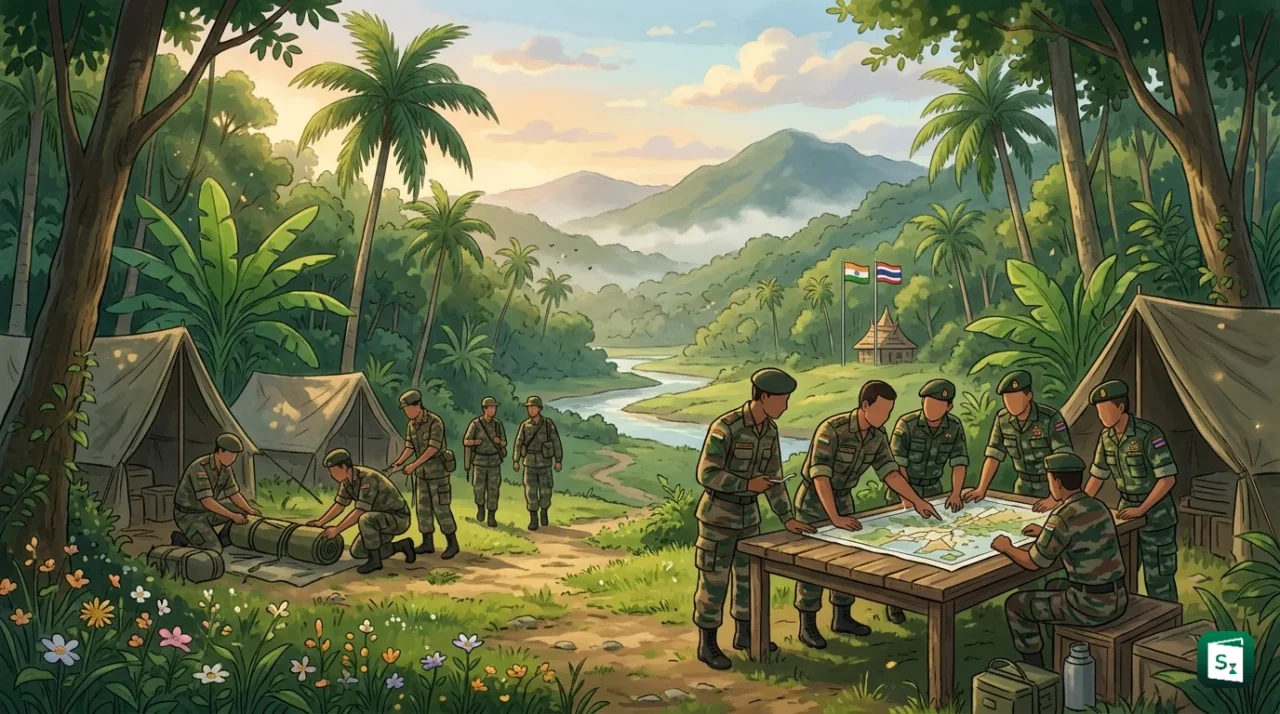
The 15th edition of the India-Thailand joint military exercise MAITREE-XV is underway at Vibhavadi Rangsit Camp in Surat Thani, Thailand from 18 to 31 August 2026. The Indian Army contingent of 85 personnel, drawn primarily from the 9 Gorkha Rifles, departed on 17 August to train alongside an equal strength contingent of the Royal Thai Army. The two-week drill focuses on joint counter-insurgency and counter-terrorism operations in jungle and semi-urban terrain under the framework of Chapter VII of the United Nations Charter.
What Is Exercise MAITREE-XV?
Exercise MAITREE is a bilateral joint military exercise between the Indian Army and the Royal Thai Army. The word Maitree comes from Sanskrit and means friendship, reflecting the intent to build trust and cooperation between the two armies. The exercise is conducted as a company-level field training exercise, which means a unit of about 80 to 120 soldiers from each side trains together as one integrated company.
MAITREE-XV is the 15th edition in the series. It is hosted alternately by India and Thailand. The current edition is hosted by Thailand, while the previous edition, MAITREE-XIV, was hosted by India at the Foreign Training Node, Umroi in Meghalaya from 1 to 14 September 2025. The exercise provides a platform to share tactics, techniques and procedures, improve interoperability (the ability of two armies to operate together smoothly), and build camaraderie through joint living, training and cultural exchange.
Background and Evolution of Exercise MAITREE
Exercise MAITREE was instituted in 2006 as part of the bilateral military to military exchange programme between India and Thailand. When it was first launched, it was called the Thai-Indian Cooperation Field Exercise (TICAFE). The name was changed to MAITREE in 2013 to better reflect the spirit of friendship. Although described as an annual exercise, there have been gaps in some years due to operational and scheduling reasons.
Since its inception, the scope of the exercise has expanded. Early editions focused on basic platoon level drills and familiarisation. Later editions shifted to realistic, integrated training for counter-insurgency and counter-terrorism operations, with special attention to jungle warfare and semi-urban combat, which are relevant to both countries. Locations have included Krabi in Thailand (2016), Bakloh in Himachal Pradesh (2017), Chachoengsao in Thailand (2018), Umroi in Meghalaya (2019), Fort Vachiraprakan in Tak Province, Thailand (2024), and Umroi again in 2025.
The exercise is conducted under the mandate of Chapter VII of the United Nations Charter. Chapter VII, titled Action with Respect to Threats to the Peace, Breaches of the Peace, and Acts of Aggression, empowers the United Nations Security Council to authorise measures, including the use of force, to restore international peace and security. In the context of MAITREE, it means troops rehearse procedures for peace enforcement operations where force may be authorised to handle terrorist or insurgent threats.
MAITREE-XV 2026: Key Details and Participants
The 2026 edition brings together carefully balanced contingents and a clear operational design.
Location: Vibhavadi Rangsit Camp, Surat Thani
The exercise is being held at Vibhavadi Rangsit Camp in Surat Thani. Surat Thani is a province in southern Thailand, located on the Malay Peninsula. The camp is a major facility of the Royal Thai Army and offers access to dense jungle, coastal and semi-urban training areas, which makes it suitable for testing survival, navigation and close quarter battle skills in conditions that mimic real insurgent and terrorist environments. The Indian contingent departed from India on 17 August 2026, and the exercise runs till 31 August 2026, lasting 14 days.
Troops and Operational Focus
Both armies have fielded 85 personnel each. The Indian contingent is represented primarily by troops from the 9 Gorkha Rifles, a well regarded infantry regiment. The Thai contingent is represented by personnel from the 3rd Battalion, 25th Infantry Brigade, 5th Division of the Royal Thai Army. At company strength, the two sides form a combined force for joint planning and joint execution.
| Feature | Detail |
|---|---|
| Edition | 15th edition, MAITREE-XV |
| Duration | 18 to 31 August 2026 |
| Host | Thailand at Vibhavadi Rangsit Camp, Surat Thani |
| Strength | 85 personnel from Indian Army and 85 personnel from Royal Thai Army |
| Indian Unit | 9 Gorkha Rifles |
| Thai Unit | 3rd Battalion, 25th Infantry Brigade, 5th Division |
| Level | Company-level joint training |
| Mandate | Chapter VII of the United Nations Charter |
| Terrain | Jungle and semi-urban |
| Previous Edition | MAITREE-XIV, 1 to 14 September 2025, Umroi, Meghalaya |
The stated aim is to enhance the combined capability to execute joint counter-insurgency and counter-terrorism operations in difficult terrain, with a focus on interoperability, joint planning and mutual learning.
The Tactical Training Agenda
The training is phased to move from learning to joint application and finally to a combined validation.
The early phase includes lectures, combat discussions and demonstrations. These cover contemporary equipment, weapons, surveillance tools and the operational experience of each army. This is followed by field training exercises where soldiers practise together on the ground.
Core tactical drills rehearsed in MAITREE-XV include creation of a Joint Operation Centre and an Intelligence and Surveillance Centre, employment of drones and counter-drone systems, securing a landing site, small team insertion and extraction, special heliborne operations, cordon and search operations, room intervention (clearing buildings held by hostile elements), and demolition of illegal structures. Supporting skills include weapon training, rappelling, jungle survival techniques, navigation, communication exercises, combat first aid and casualty evacuation. Physical fitness and combat readiness are given strong emphasis, with joint martial arts, games and specialised physical training. Past editions have also featured cultural activities like yoga sessions to strengthen interpersonal bonds.
The programme culminates in a validation exercise, a continuous 48 hour operation that tests the combined force under realistic conditions. In this final test, the integrated company must plan together, share intelligence, coordinate manoeuvre, and neutralise simulated insurgent threats in semi-urban and jungle settings, demonstrating that the two armies can act as one unit.
9 Gorkha Rifles: The Indian Contingent
The Indian side in MAITREE-XV is led by the 9 Gorkha Rifles, one of the most storied infantry regiments of the Indian Army. The regiment traces its origin to 1817, when it was raised as the Fatehgarh Levy. It was renamed the Mynpoory Levy in 1818, became the 63rd Regiment of Bengal Native Infantry in 1823, and was designated the 9th Gurkha Rifles in 1903. After independence, it was transferred to the Indian Army under the Tripartite Agreement of 1947 between India, Nepal and the United Kingdom.
The 9 Gorkha Rifles is one of the seven Gorkha regiments in the Indian Army, the others being 1, 3, 4, 5, 8 and 11 Gorkha Rifles. Its Regimental Centre is in Varanasi, Uttar Pradesh. Soldiers are recruited primarily from the Khas Chhetri and Thakuri communities of Nepal, with about 20 percent from domiciled Indian Gorkhas. The regiment’s motto is Kafar Hunu Bhanda Marnu Ramro, which means Better to die than live like a coward, and its war cry is Jai Maha Kali, Ayo Gorkhali, meaning Hail Goddess Kali, The Gorkhas are here. Its insignia is a pair of crossed khukris with the numeral 9, the khukri being the curved traditional knife of the Gorkhas.
The regiment has a distinguished record. It has been honoured with three Victoria Crosses, one Ashoka Chakra, five Maha Vir Chakras and seventeen Vir Chakras, among other gallantry and service awards. Its post-independence battle honours include Phillora in the 1965 war, Kumarkhali and Dera Baba Nanak. With five to six battalions and extensive experience in counter-insurgency, high altitude and jungle operations, the regiment brings valuable operational knowledge to a jungle and semi-urban exercise like MAITREE.
Why This Exercise Matters: Strategic Context
MAITREE is more than a tactical drill. It sits within a wider political and strategic framework that links India and Thailand.
For India, Thailand is a key partner in the Act East Policy, which seeks deeper economic, connectivity and security engagement with Southeast Asia and the Indo-Pacific. For Thailand, engagement with India is guided by its Act West Policy. The two policies complement each other and have driven institutional ties across forums such as ASEAN, the Bay of Bengal Initiative for Multi-Sectoral Technical and Economic Cooperation (BIMSTEC), the Mekong-Ganga Cooperation (MGC) and the Indian Ocean Rim Association (IORA). In April 2025, during Prime Minister Narendra Modi’s visit to Bangkok for the 6th BIMSTEC Summit, India and Thailand elevated their ties to a Strategic Partnership after talks with Thai Prime Minister Paetongtarn Shinawatra. The partnership covers defence, security, maritime safety, cybercrime, trade and connectivity, including the India-Myanmar-Thailand Trilateral Highway.
India Thailand Defence Cooperation Beyond MAITREE
Defence cooperation rests on a Memorandum of Understanding on Defence Cooperation signed on 25 January 2012. Since then, cooperation has expanded through regular exchanges and joint activities.
| Service | Exercise / Mechanism | Nature |
|---|---|---|
| Army | Exercise MAITREE | Annual bilateral joint military exercise since 2006 |
| Army (Multilateral) | Exercise Cobra Gold | Thailand’s multinational exercise, India participates as Observer Plus |
| Navy | Indo-Thai Coordinated Patrol (CORPAT) | Biannual patrolling along the International Maritime Boundary Line in the Andaman Sea since 2005, focused on preventing smuggling, piracy, illegal fishing and illegal immigration, and on search and rescue |
| Navy (Trilateral) | SITMEX (Singapore-India-Thailand Maritime Exercise) | Annual trilateral naval exercise announced in 2018 at the Shangri-La Dialogue, first edition off Port Blair in 2019 |
| Air Force | Exercise SIAM Bharat | Annual bilateral air force exercise |
In June 2026, India and Thailand held the 10th Defence Dialogue in Bangkok, co-chaired by India’s Joint Secretary for Defence and Thailand’s Deputy Permanent Secretary for Defence. The dialogue reviewed military to military engagements, defence industry cooperation, and coordination under ASEAN-led mechanisms. Regular jungle and semi-urban training under MAITREE helps both armies address shared challenges from terrorism and insurgency, while maritime cooperation secures vital sea lanes in the Andaman Sea and the wider Indo-Pacific, where both countries are maritime neighbours.
The long-standing cultural link, from Buddhist heritage to the Indian diaspora of about 4 to 5 lakh people in Thailand, adds depth to the strategic trust that defence exercises like MAITREE reinforce.
The Way Forward
The immediate outcome of MAITREE-XV will be measured by how seamlessly the two contingents execute joint missions during the final validation. Successful integration will feed into standard operating procedures that both armies can use in future peacekeeping and counter-terrorism deployments. The lessons will cover joint command and control, use of drones and counter-drone systems, and coordination for heliborne insertion in jungle terrain.
At the strategic level, regular and realistic exercises help sustain momentum after the 2025 Strategic Partnership and the 2026 Defence Dialogue. The next step is to carry forward the interoperability gained in MAITREE into wider areas, including defence manufacturing, research and innovation, humanitarian assistance and disaster relief, and maritime domain awareness in the Andaman Sea. As both countries work to complete connectivity projects and strengthen cooperation under ASEAN and BIMSTEC, a reliable military to military channel ensures that security remains tightly linked to diplomacy and economic engagement.
Key Takeaways
- Exercise MAITREE-XV, the 15th edition of the India-Thailand joint military exercise, is being held from 18 to 31 August 2026 at Vibhavadi Rangsit Camp, Surat Thani, Thailand.
- The Indian Army contingent of 85 personnel is drawn primarily from the 9 Gorkha Rifles, while the Royal Thai Army fields 85 personnel from the 3rd Battalion, 25th Infantry Brigade, 5th Division.
- The exercise is a company-level drill focused on joint counter-insurgency and counter-terrorism operations in jungle and semi-urban terrain under Chapter VII of the United Nations Charter.
- Exercise MAITREE was instituted in 2006 as TICAFE and renamed MAITREE, meaning friendship in Sanskrit, in 2013, and is hosted alternately by India and Thailand.
- The previous edition, MAITREE-XIV, was held from 1 to 14 September 2025 at the Foreign Training Node, Umroi, Meghalaya, while MAITREE-XIII was held in Tak Province, Thailand in July 2024.
- The 9 Gorkha Rifles, raised in 1817 as the Fatehgarh Levy with Regimental Centre at Varanasi, is one of the seven Gorkha regiments of the Indian Army and carries the motto Kafar Hunu Bhanda Marnu Ramro.