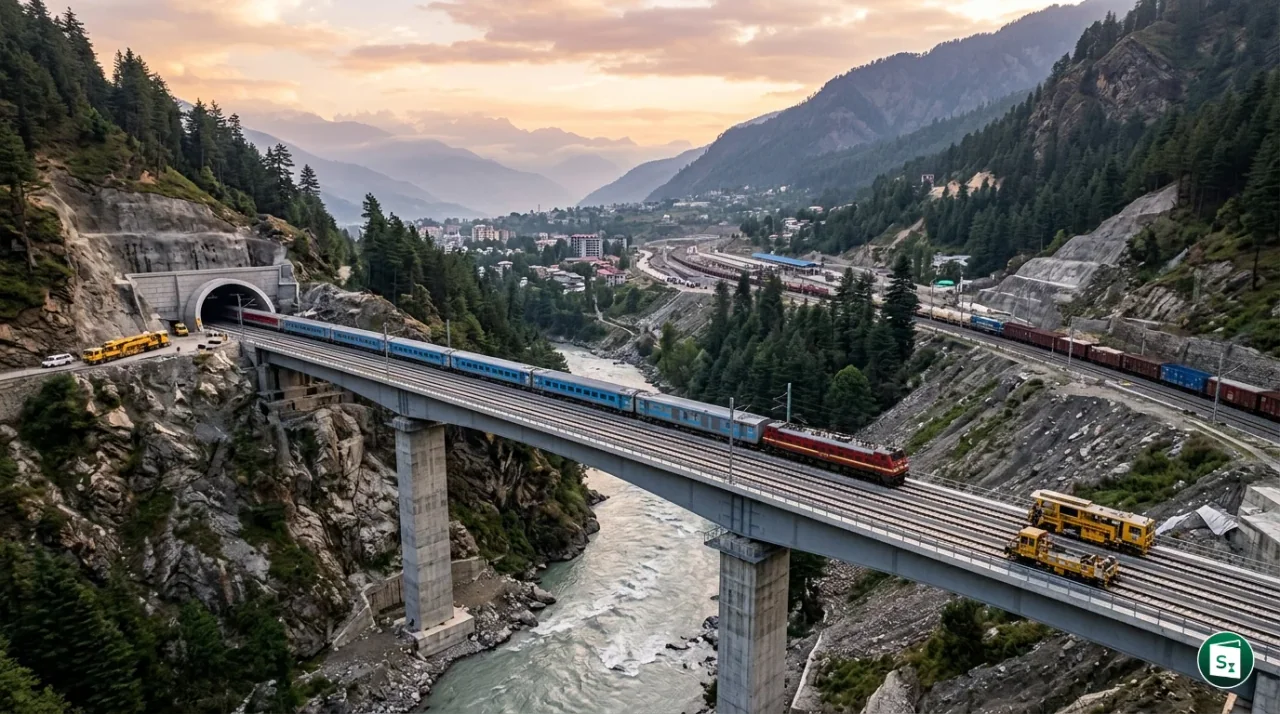
The Ministry of Railways sanctioned three major rail infrastructure projects with a combined investment of ₹2,193 crore on May 20, 2026. The approved works target critical safety upgrades on the Himalayan Jammu-Shri Mata Vaishno Devi Katra section, capacity expansion on the high-density Howrah-Delhi route via a third line between Kiul and Jhajha, and track doubling to strengthen the Chennai suburban rail network. These projects aim to enhance passenger safety, reduce freight congestion, and support regional economic growth across different zones of Indian Railways.
Safety and Infrastructure Upgrades on the Jammu-Katra Section
The Jammu-Shri Mata Vaishno Devi Katra railway line is one of India’s most challenging and strategically vital rail links. The Ministry of Railways has approved an investment of ₹238 crore specifically for safety reinforcement and infrastructure rehabilitation along this section. This funding is dedicated to mitigating geological hazards and ensuring uninterrupted connectivity.
Key Components of the Katra Section Upgrades
The approved works focus on three critical engineering areas to secure the route against the harsh Himalayan environment. First, slope stabilisation is a priority as the section traverses fragile mountainous terrain prone to landslides. Engineers will install steel geo-grids, execute rock-bolting, and build concrete retaining walls at vulnerable rock faces.
Second, tunnel rehabilitation will address the persistent challenge of water seepage inside Himalayan tunnels. Structural lining, waterproofing, and specialized grouting will prevent moisture from damaging overhead traction lines or corroding tracks. Finally, bridge protection works will reinforce bridge piers and abutments with concrete jacketing to shield them from flash floods and mountain debris.
Strategic Importance and the USBRL Context
This 78-km rail section is a core component of the larger Udhampur-Srinagar-Baramulla Rail Link (USBRL) project, which integrates the Kashmir Valley with the national rail grid. The Jammu-Udhampur stretch opened in April 2005, followed by the inauguration of the Udhampur-Katra section by Prime Minister Narendra Modi on July 4, 2014.
Administered by the Northern Railway zone, which is headquartered in New Delhi, this single-line track is highly saturated due to the heavy volume of passenger traffic, primarily pilgrims traveling to the Vaishno Devi shrine. Because the difficult terrain, tight curves, and dense tunnels make conventional double-tracking impossible, these safety interventions are critical to maintaining the structural integrity of the existing line while an alternate route is being planned.
Capacity Expansion: Kiul-Jhajha 3rd Line Project
To address severe traffic congestion on the high-density Eastern corridor, the government approved the Kiul-Jhajha 3rd line project at an estimated cost of ₹962 crore. This project involves laying a new 54-km third track between the Kiul and Jhajha stations in Bihar. This section serves as a key bottleneck on the busy mainline connecting Delhi and Kolkata.
Enhancing High-Density Route Operations
This corridor falls under the jurisdiction of the Danapur division of the East Central Railway zone, which has its headquarters in Hajipur, Bihar. The existing double-line section is currently saturated, which causes delays for both passenger and freight services. Adding a third line will separate slow-moving freight trains from express passenger services, thereby improving overall operational speed and punctuality.
This line is also crucial for regional freight logistics. It facilitates the smooth movement of bulk commodities such as coal, iron ore, and cement. By connecting key industrial centers and thermal power plants to major ports, the project supports economic expansion and eases supply chain constraints in eastern India.
Strengthening the Chennai Suburban Rail Network: Arakkonam-Chengalpattu Doubling
To enhance the public transit and industrial logistics network of Tamil Nadu, the Ministry of Railways sanctioned the Arakkonam-Chengalpattu doubling project. This project is estimated at a cost of ₹993 crore and will involve doubling the tracks along a 68-km section. This corridor connects two major rail junctions on the periphery of Chennai.
Industrial and Freight Growth Impact
This project is managed by the Chennai division of the Southern Railway zone, which has its headquarters in Chennai. The section forms a vital link in the Chennai Suburban Circular Rail Network, connecting Chennai Beach, Tambaram, Chengalpattu, and Arakkonam. Because the existing single-line track is highly congested, doubling it will allow Southern Railway to run more frequent suburban commuter trains and improve overall punctuality.
The line is also strategically important for industrial transport. It passes through major manufacturing and economic hubs, including Mahindra World City, Sriperumbudur, Oragadam, and Irungattukottai. These areas house massive automobile, steel, electronics, and cement industries. Doubling the tracks will facilitate faster and more efficient transit of freight, including cars, steel, and food grains. Additionally, the route runs close to Kancheepuram, the site of the proposed Parandur Airport project, ensuring that the rail line is well-positioned to handle future cargo and passenger traffic growth from the upcoming aviation hub.
Key Takeaways
- The Ministry of Railways sanctioned three major rail projects on May 20, 2026, with a total allocation of ₹2,193 crore across three states.
- A safety and infrastructure upgrade worth ₹238 crore was approved for the Jammu-Shri Mata Vaishno Devi Katra section, which is part of the larger Udhampur-Srinagar-Baramulla Rail Link (USBRL) project.
- The Kiul-Jhajha 3rd line project in Bihar is a 54-km capacity expansion project costing ₹962 crore under the East Central Railway zone.
- The Arakkonam-Chengalpattu doubling project in Tamil Nadu, costing ₹993 crore, will double the 68-km section under the Southern Railway zone.
- The Arakkonam-Chengalpattu section serves the Chennai Suburban Circular Rail Network and major manufacturing hubs like Mahindra World City and Sriperumbudur.