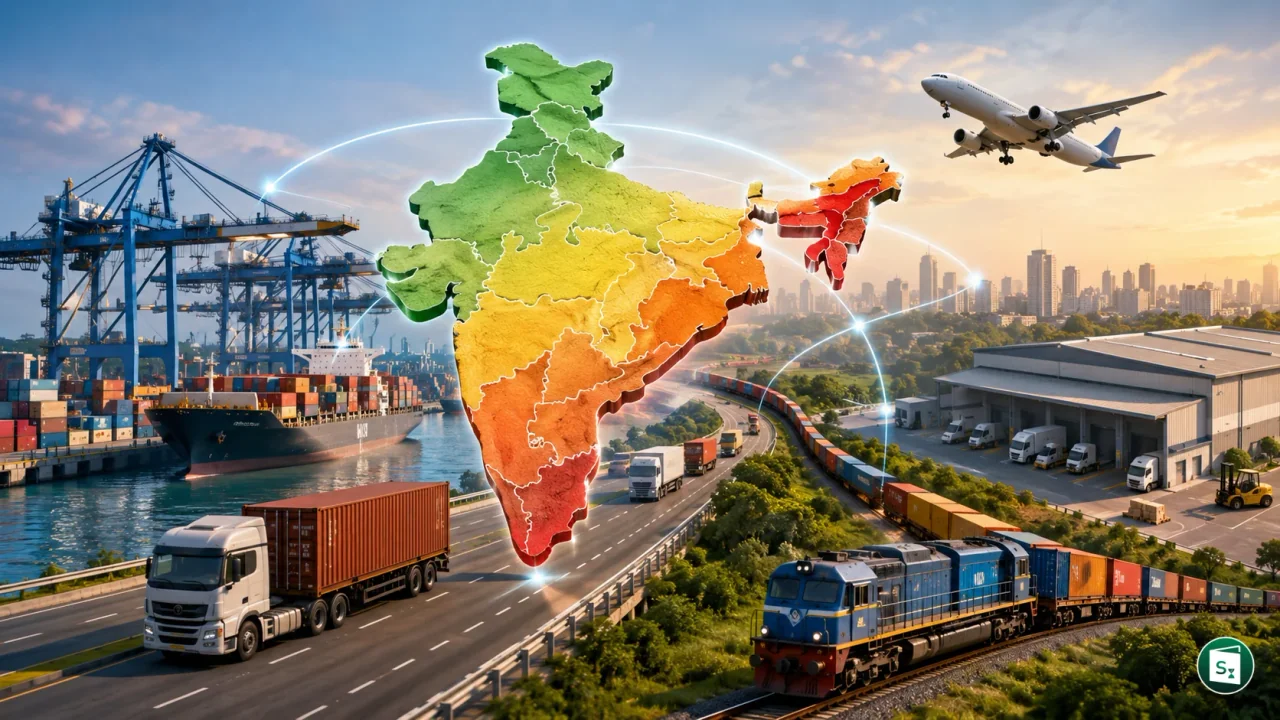
Union Minister for Commerce and Industry Piyush Goyal released the seventh edition of the Logistics Ease Across Different States (LEADS) 2025 report in New Delhi on May 13, 2026. The publication was unveiled during the Logistics Excellence, Advancement and Performance Shield (LEAPS) Awards 2025 ceremony, which honors leaders and innovators in the logistics sector. The report benchmarks states and union territories using a revised performance framework, highlighting their progress in reducing logistics costs and improving supply chain efficiency.
What is the LEADS Report?
The Logistics Ease Across Different States (LEADS) report is a diagnostic tool and benchmarking framework designed by the Department for Promotion of Industry and Internal Trade (DPIIT) under the Ministry of Commerce and Industry. First launched in 2018, the report was inspired by the World Bank’s global Logistics Performance Index (LPI), adapting it to the Indian subnational context. The primary objective of the LEADS initiative is to identify logistics challenges faced by states and union territories, provide actionable recommendations, and promote competitive federalism in the logistics sector.
By benchmarking the performance of states and union territories, the LEADS report helps them formulate policies to lower logistics costs, improve regulatory environments, and enhance supply chain infrastructure. The annual exercise assists the government in aligning state-level initiatives with national frameworks, specifically the PM GatiShakti National Master Plan and the National Logistics Policy (NLP). Over the years, the report has evolved to capture the rapid changes in India’s logistics landscape, incorporating more data-driven indicators and refined methodology.
The New Four-Tier Performance Framework
To better capture the maturity and developmental stages of different regions, the LEADS 2025 framework transitioned from a three-tier to a four-tier performance framework. The earlier system classified regions as Achievers, Fast Movers, and Aspirants. The new four-tier system classifies states and union territories into Exemplars, High Performers, Accelerators, and Growth-Seekers. This grading allows for a more granular assessment of progress and helps states design targeted policy interventions.
The classification is further divided across four distinct groups based on geographic and economic characteristics: Coastal states, Landlocked states, North-Eastern states, and Union Territories. This division ensures that states with natural logistics advantages, like coastlines, are compared fairly against landlocked or mountainous regions.
Category-wise Classification of States and UTs
The states and union territories have been categorized based on their performance under the four tiers. The following table details the distribution of states and union territories across the performance categories:
| Category | Coastal States | Landlocked States | North-Eastern States | Union Territories |
|---|---|---|---|---|
| Exemplars | Tamil Nadu | Uttar Pradesh | Mizoram | Delhi |
| High Performers | Gujarat, Kerala, Maharashtra | Haryana, Telangana, Chhattisgarh, Bihar | Tripura, Meghalaya | Jammu & Kashmir, Puducherry |
| Accelerators | Andhra Pradesh, Odisha, Goa, Karnataka | Punjab, Jharkhand, Madhya Pradesh, Uttarakhand, Himachal Pradesh | Nagaland, Arunachal Pradesh, Manipur, Assam | Dadra & Nagar Haveli and Daman & Diu, Chandigarh, Ladakh, Lakshadweep |
| Growth-Seekers | West Bengal | Rajasthan | Sikkim | Andaman & Nicobar Islands |
Key Highlights of the LEADS 2025 Methodology
The LEADS 2025 methodology focuses on ensuring a data-driven and transparent assessment of India’s logistics landscape. To increase the reliability of the rankings, the framework assigns 59 percent weightage to objective, measurable indicators, with the remaining 41 percent weightage allocated to perception-based inputs from industry stakeholders. This balanced approach combines hard operational data with real-world feedback from logistics operators, exporters, and transporters.
The benchmarking process evaluates states and union territories across three core pillars:
- Infrastructure: This pillar assesses the quality and availability of physical infrastructure, including road networks, rail connectivity, airports, ports, inland container depots, and warehousing facilities.
- Services: This pillar measures the efficiency, reliability, and capacity of logistics service providers, such as shipping lines, road transport operators, and custom house agents.
- Operating and Regulatory Environment: This pillar evaluates the ease of obtaining clearances, state-level logistics policies, safety and security of cargo, and the implementation of digital systems like single-window portals.
By comparing states within their respective categories, the methodology ensures a fair comparison. For instance, landlocked states face different geographical barriers compared to coastal states, and north-eastern states operate with unique hilly terrains. The resulting insights help states identify specific bottlenecks and prioritize reforms to reduce overall transit times and operational costs.
LEAPS 2025 Awards
The Logistics Excellence, Advancement and Performance Shield (LEAPS) Awards 2025 were held alongside the release of the LEADS report in New Delhi. Spearheaded by the DPIIT, the awards celebrate the contributions of private enterprises, startups, MSMEs, and academic institutions in streamlining India’s supply chains. The awards are structured across 13 categories, focusing on logistics innovation, technological adoption, and sustainable operations.
The following table highlights some of the key winners recognized during the LEAPS 2025 awards ceremony:
| Award Category | Recipient |
|---|---|
| Air Freight Service Provider | FedEx Express Transportation and Supply Chain Services (India) |
| Maritime Freight Service Provider | MSC Agency India |
| Road Freight Service Provider | Safexpress |
| Rail Freight Service Provider | DP World Rail Logistics |
| Multimodal Logistics Service Provider | Indev Infra Private Limited |
| E-commerce Logistics Delivery Services | Delhivery |
| Education Institute Promoting Logistics | IIM Mumbai |
| Startup (Technology and Operations) | MatchLog Solutions |
These awards aim to encourage best practices in the private sector and promote public-private partnerships. By recognizing excellence in service delivery and technology integration, the initiative seeks to build a highly competitive and resilient logistics ecosystem across India.
Significance and Strategic Alignment
The LEADS benchmarking exercise plays a crucial role in implementing India’s broader economic and infrastructure policies. It is designed to complement the PM GatiShakti National Master Plan, which focuses on integrated planning and multimodal connectivity across railways, roadways, waterways, and airways. While PM GatiShakti addresses physical infrastructure bottlenecks, the LEADS framework focuses on regulatory and service-oriented reforms, ensuring that administrative processes do not delay cargo transit.
Reducing logistics costs is a major national priority. Currently, logistics expenses in India account for approximately 13 to 14 percent of the Gross Domestic Product (GDP). The National Logistics Policy (NLP), launched in 2022, targets lowering this cost to a single-digit level of around 8 percent to align with global benchmarks. Achieving this reduction is vital for boosting the competitiveness of Indian exports, supporting MSMEs, and making the domestic manufacturing sector more attractive under the Make in India initiative.
By introducing a new four-tier classification, the framework also strengthens cooperative and competitive federalism. It encourages states to learn from the administrative successes of Exemplars and implement reforms like digitized single-window clearances, simplified transport permits, and enhanced warehouse safety standards. Ultimately, these subnational improvements are expected to elevate India’s rank on the World Bank’s global Logistics Performance Index (LPI), attracting higher foreign direct investment into the industrial sector.
Key Takeaways
- The Logistics Ease Across Different States (LEADS) framework was first launched in 2018 by the Department for Promotion of Industry and Internal Trade (DPIIT).
- The LEADS 2025 report introduced a four-tier performance classification consisting of Exemplars, High Performers, Accelerators, and Growth-Seekers.
- Under the LEADS 2025 assessment, Tamil Nadu, Uttar Pradesh, Mizoram, and Delhi were categorized as Exemplars for their sustained logistics excellence.
- The LEADS 2025 assessment methodology assigns 59 percent weightage to objective indicators and 41 percent weightage to perception-based feedback.
- The Logistics Excellence, Advancement and Performance Shield (LEAPS) Awards 2025 honored logistics leaders across 13 distinct categories.
- The LEADS framework aligns with the National Logistics Policy (NLP) of 2022, which aims to reduce India’s logistics costs to 8 percent of GDP.